
Expert analysis of Stanley Spencer’s Map Reading
Style: Neo-Romanticism · Genre: symbolic painting
Expert Analysis: "Map Reading" by Stanley Spencer
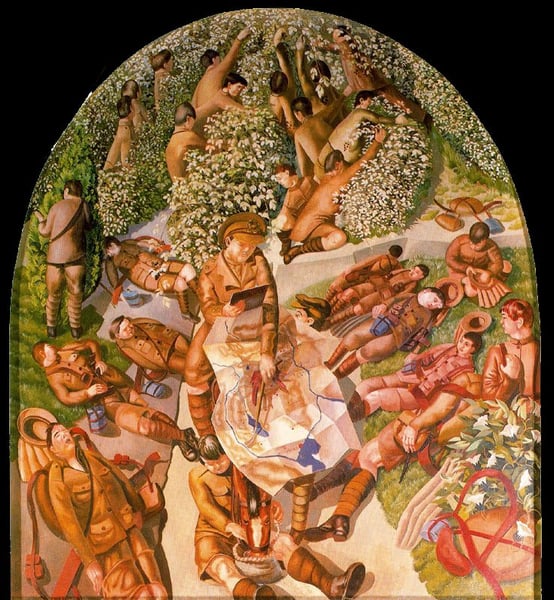
Stanley Spencer’s Map Reading stands as a compelling example of British Neo-Romanticism, a movement that emerged in the 1930s and 1940s as a reaction against both industrialization and abstract modernism. Neo-Romanticism sought to re-enchant the everyday landscape and human experience, often imbuing them with a dreamlike, spiritual, or symbolic intensity. Spencer was a central—if idiosyncratic—figure in this tradition, and Map Reading distills his signature approach: the fusion of the mundane with the transcendent.
Within the genre of symbolic painting, the act of reading a map is never merely literal. Spencer transforms this ordinary activity into a metaphor for human longing, uncertainty, and the search for meaning. The figures are typically depicted in a landscape that feels both familiar and strange—a hallmark of Neo-Romanticism, where the British countryside becomes a stage for psychological and spiritual drama. The map itself functions as a symbol of navigation through life, yet the characters’ absorption suggests they may be lost or in need of direction, a theme that resonated deeply in the post-war context of dislocation and reconstruction.
What makes Map Reading significant within its style and period is Spencer’s unique handling of space, perspective, and emotional intensity. Unlike the more pastoral or nostalgic Neo-Romantic works of artists like John Minton or Graham Sutherland, Spencer’s vision is intensely personal and often unsettling. His figures are rendered with a deliberate awkwardness—enlarged heads, strained poses—that heightens the psychological weight of the scene. The composition likely draws the viewer into a charged stillness, where the act of reading becomes a form of prayer or meditation.
Spencer’s Neo-Romanticism is also distinguished by its grounding in his own biography and community (notably his time in Cookham, Berkshire). Map Reading can be seen as part of his lifelong project to find the sacred in the ordinary. The map becomes a symbol of the intersection between the divine and the daily—a theme that elevates the painting beyond mere illustration into a profound commentary on the human condition. In this way, the artwork captures the essence of Neo-Romanticism: a poetic, symbolic exploration of inner truth through the lens of the familiar world.
Visually similar
20 works with related composition and palette
Map Reading
Stanley Spencer
Dug Out (or Stand To)
Stanley Spencer
Dug-out (Stand-to)
Stanley Spencer

Kit inspection
Stanley Spencer
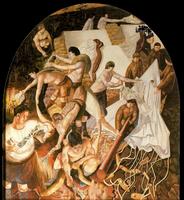
Making a fire belt
Stanley Spencer
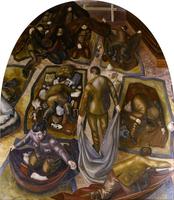
Kit Inspection
Stanley Spencer
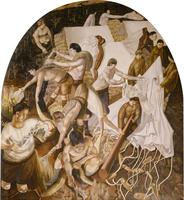
Making a Firebelt
Stanley Spencer
Death of Commissar
Kuzma Petrov-Vodkin
Memory of the Halls of Mirrors in Brussels
Otto Dix

Bridesmaids at Cana
Stanley Spencer
Resurrection. The Reunion of Families
Stanley Spencer
Resurrection. The Hill of Zion
Stanley Spencer

Burners (right)
Stanley Spencer

The Template (right)
Stanley Spencer
Ablutions
Stanley Spencer
The People's Land
Boris Grigoriev

The Resurrection - Waking Up 2
Stanley Spencer

The Resurrection - Waking Up
Stanley Spencer

Welders (right)
Stanley Spencer
Convoy of Wounded Men Filling Water Bottles at a Stream
Stanley Spencer