
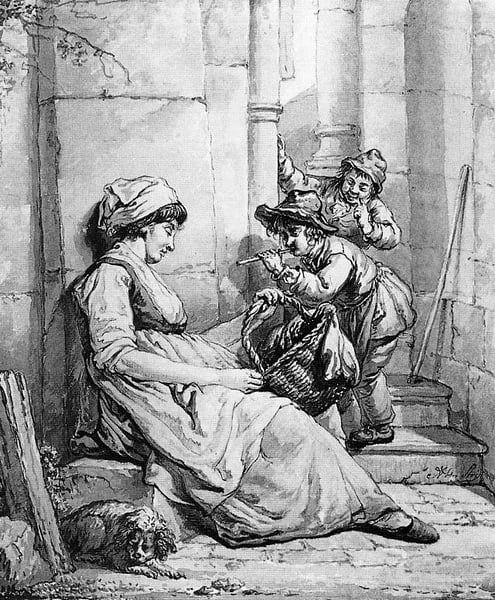
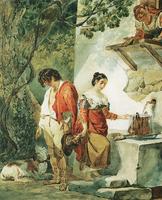
Sleeping woman teased by two boys
Analisi esperta di Sleeping woman teased by two boys di Abraham van Strij
Stile: Neoclassicism · Genere: genre painting
This analysis of Abraham van Strij’s Sleeping woman teased by two boys is based solely on the provided structured facts.
Significance within Neoclassicism and Genre Painting
Abraham van Strij’s Sleeping woman teased by two boys occupies a fascinating intersection between the high-minded ideals of Neoclassicism and the intimate, everyday observations of Dutch genre painting. Its significance lies in how it adapts Neoclassical principles—order, clarity, and moral subtext—to a domestic, even playful, subject that would traditionally belong to the realm of rococo frivolity or Dutch Golden Age anecdotal scenes.
Neoclassical Form Meets Genre Subject
- Formal Restraint: Despite the humorous, mischievous theme—two boys sneaking up on a sleeping woman—the composition is likely governed by Neoclassical clarity. Van Strij would have employed balanced groupings, firm contours, and a controlled, even light source to structure the scene, avoiding the chaotic energy typical of earlier genre works. This disciplined arrangement elevates the momentary prank into a studied tableau.
- Moral Undercurrent: Neoclassicism prized moral instruction. The teasing of a vulnerable, sleeping woman carries a cautionary undertone—perhaps a gentle warning about impropriety, the breach of decorum, or the consequences of carelessness. This moralizing layer, delivered through a seemingly lighthearted genre scene, marks a distinct departure from the purely sensual or comic genre paintings of the Baroque or Rococo.
- Bridging Traditions: Van Strij, a Dutch artist working in the late 18th and early 19th centuries, was part of a generation that assimilated Neoclassicism while remaining rooted in the Netherlandish love for accurate domestic observation. The painting thus demonstrates how Neoclassical ideals of composition and theme could be applied not only to mythological or historical narratives, but also to the quotidian life of the middle class—making the movement more accessible and less overtly heroic.
Art-Historical Position
The work is significant as a marker of stylistic transition. It shows Neoclassicism infiltrating the democratic genre scene, a domain often resistant to its stern doctrines. By casting a spontaneous, teasing moment within a formal Neoclassical framework, van Strij creates a hybrid that enriches our understanding of how Neoclassicism was adapted outside of its epicentre in France and Italy, particularly in the Dutch Republic’s continuing tradition of meticulous, observant interior scenes.
Visivamente simili
20 opere con composizione e palette affini
Seller with two children and cobbler
Saverio della Gatta
Two Roman ladies and their children
Penry Williams
Chat in Venice
Antonio Paoletti
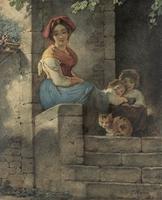
Young Italian from Olevano with children and cat
Ernst Meyer
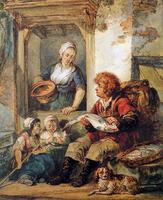
Fish salesman at woman and chidren
Abraham van Strij
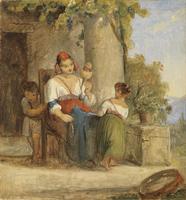
Italian genre scene
Ernst Meyer
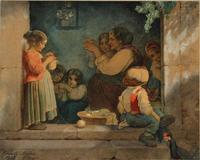
A knitting lesson
Ernst Meyer
In Tivoli
Bartolomeo Pinelli
Peasants at the fountain said before
Ernest Hébert
Charity relieving Distress
Thomas Gainsborough
The Stray Kitten
William Collins
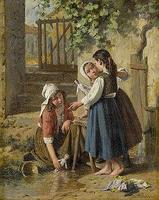
The doll's bathing day
Pierre Jean Edmond Castan
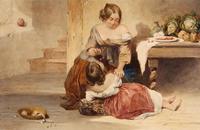
A mother feeding her little daughter with a bunch of cherries in a farmhouse kitchen
Alfred Downing Fripp
Die Gartenlaube
Toby Edward Rosenthal
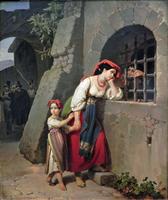
Visit to the Prison
Theodor Leopold Weller
Young flower seller
Guerrino Guardabassi
Play Time
Giovanni Battista Torriglia
Loves light
Filippo Indoni
Die Gartenlaube
Toby Edward Rosenthal
An Interrupted Date
Karl Bryullov