
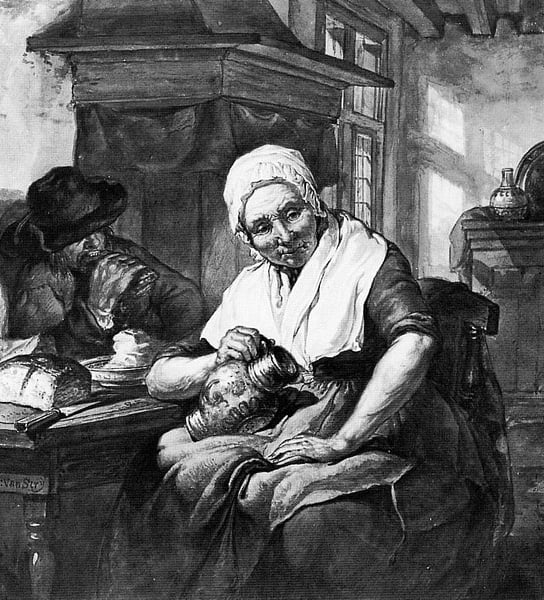
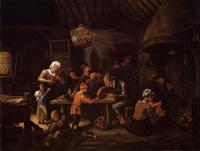
Interior with a woman and man
Abraham van Strij sanatçısının Interior with a woman and man eseri hakkında uzman analizi
Tarz: Neoclassicism · Tür: genre painting
Expert Analysis: "Interior with a woman and man" by Abraham van Strij
Abraham van Strij’s Interior with a woman and man is a quintessential example of how Neoclassical principles were adapted to the intimate, domestic realm of genre painting in the late 18th and early 19th centuries. While Neoclassicism is often associated with grand historical or mythological subjects, van Strij brings its core values—clarity, order, and moral restraint—into the quiet, everyday life of a Dutch interior.
Significance within its Style and Period
-
A Neoclassical Reading of Everyday Life: Unlike the dramatic chiaroscuro and bustling informality of Baroque genre scenes, van Strij’s composition is marked by a serene, balanced arrangement. The figures are likely engaged in a restrained, possibly moral interaction, reflecting the Neoclassical emphasis on virtue and emotional moderation. The interior itself—clean lines, subdued palette, and a sense of calm—echoes the Neoclassical preference for harmony and simplicity over Baroque excess.
-
Bridge Between Golden Age Tradition and Neoclassical Ideals: Van Strij consciously revives the 17th-century Dutch domestic interior tradition (think Vermeer or de Hooch), but he updates it with a more polished, linear refinement typical of Neoclassicism. His handling of light, for instance, is softer and more evenly distributed, avoiding the stark contrasts that would disturb the picture’s quiet dignity. This synthesis makes his work significant as a transitional moment: it honors a national heritage while embracing Enlightenment ideals of order and clarity.
-
Moral Undertones in a Domestic Space: Dutch genre painting often carried symbolic meanings about temperance, diligence, or courtship. In van Strij’s hands, the interaction between the woman and man likely suggests a lesson in propriety or domestic virtue—a theme that aligned perfectly with Neoclassical didacticism. The interior itself, neat and well-ordered, reinforces the idea of a well-governed household as a microcosm of a well-governed society.
Conclusion
Interior with a woman and man stands out not for grand drama, but for its quiet, disciplined beauty. Van Strij demonstrates that Neoclassicism could flourish in the humblest of settings, elevating genre painting from mere anecdote to a polished, morally instructive art. His work reminds us that the Neoclassical spirit was not confined to ancient Rome or heroic myths; it could be found in the soft light of a Dutch parlour, where every object and gesture was composed with classical restraint.
Görsel olarak benzer
İlişkili kompozisyon ve renk paletine sahip 20 eser
Country interior
Le Nain brothers
Prayer before Meal
Jan Steen
A man and woman smoking a pipe seated in an interior with peasants playing cards on a table
David Teniers the Younger
The Family Meal
Le Nain brothers
Four Figures at Table
Le Nain brothers
The Feast of the Bean King
Gabriel Metsu
Baking of Flat Cakes
Bartolome Esteban Murillo
Idlers
Jan Steen
The happy family
Le Nain brothers
Prayer before Meal
Jan Steen
Interior with Card Players
David Rijckaert III
Liveliest
Jan Steen
Marriage Contract
Jan Steen
The Spinner
Pietro Longhi
Old Woman Cutting Bread
Gerrit Dou
Wealth is Looking, or, In Luxury Look Out
Jan Steen
Preparing the Polenta
Pietro Longhi
The Crepes Vendor in Quimperlé
Jules Trayer
Man Offering a Glass of Wine to a Woman
Pieter de Hooch
Lean Kitchen
Jan Steen