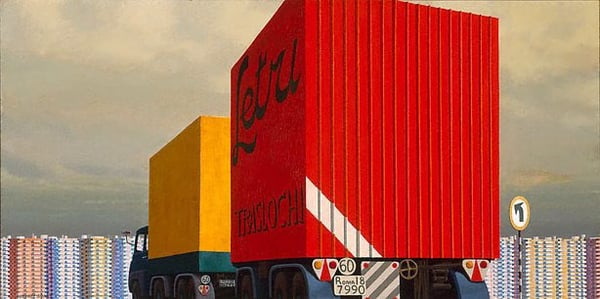
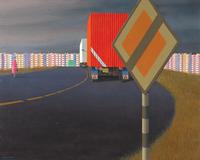
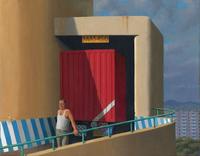
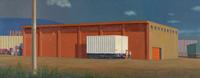
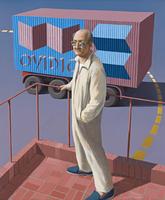
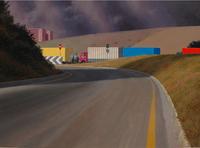
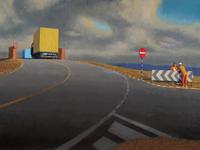
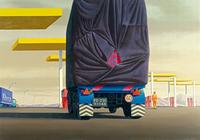
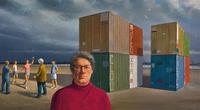
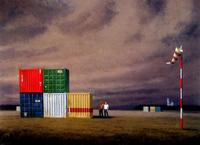
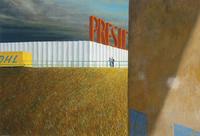
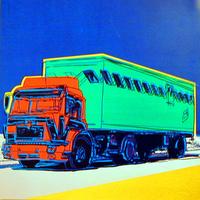
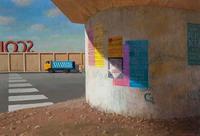
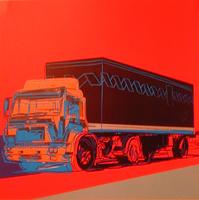
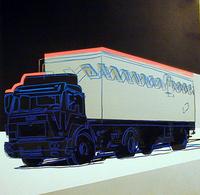
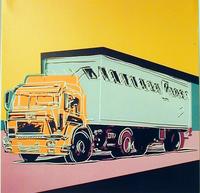
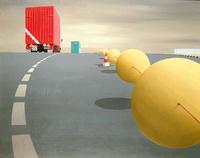
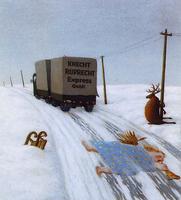
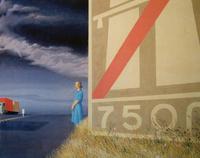
The significance of Jeffrey Smart's "Truck and trailer approaching a city" lies in its masterful synthesis of two seemingly opposing impulses—the hyper-realist pursuit of meticulous, photographic detail and the modernist cityscape’s emotional distance. As a hyper-realist work, the painting goes beyond mere imitation: every surface, reflection, and architectural edge is rendered with obsessive precision, yet the composition deliberately removes human presence and any sense of narrative warmth. The “truck and trailer” becomes a geometric cipher, its scale and trajectory creating a taut visual tension against the grid of the approaching city. This tension is the work’s core achievement—it transforms a mundane industrial scene into a meditation on isolation, direction, and the ambiguous threshold between motion and stillness. Smart’s cityscape is not a celebration of urban vitality but a cool, calculated stage where light and shadow flatten space into near-abstraction, making the ordinary feel monumental and eerily timeless. Within the hyper-realist tradition, this piece stands out for how it uses extreme fidelity to detail not for spectacle, but to amplify a sense of psychological detachment, thereby elevating the cityscape genre into a vehicle for existential quietude.