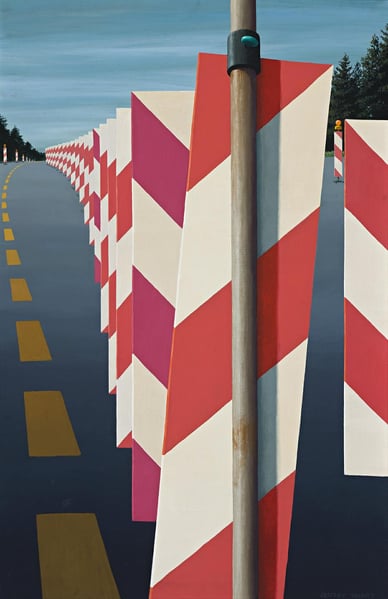
Study for 'Autobahn in the Black Forest II'
Dettagli
Analisi esperta di Study for 'Autobahn in the Black Forest II' di Jeffrey Smart
Stile: Hyper-Realism · Genere: cityscape
Expert Analysis: "Study for 'Autobahn in the Black Forest II'" by Jeffrey Smart
Jeffrey Smart (1921–2013) is celebrated for his hyper-realistic cityscapes that transform banal, often overlooked urban environments into compositions of precise, haunting geometry. This study—a preparatory work for the finished painting Autobahn in the Black Forest II—exemplifies Smart’s signature approach: the elevation of the ordinary to a near-abstract, meditative stillness.
Significance within Hyper-Realism and Smart’s Oeuvre:
-
The Hyper-Realist Dialectic: Smart’s style goes beyond mere photographic reproduction. He distills reality, adjusting perspectives and removing imperfections to create a world that feels more real than reality—a hyper-real clarity that isolates objects and spaces. In this study, the autobahn’s sweeping curve, the standard-issue guardrails, and the distant forest edge are painted with a crisp, almost architectural precision. Every shadow and highlight is controlled, lending the scene a clinical, timeless quality. This is not a snapshot of a highway; it is an idealized, archetypal image of modern transit.
-
Tension Between Nature and Infrastructure: The title pairs the man-made “Autobahn” with the mythic “Black Forest.” Smart exploits this contrast: the forest appears as a dark, uniform wall, flattened into a decorative backdrop, while the road—a ribbon of asphalt—commands the foreground with its rigorous curve. This interplay reflects Smart’s fascination with how human construction imposes order on the natural landscape. The study likely isolates this tension, editing out any distracting details (cars, people) to focus on the pure geometry of the road against the organic mass of trees.
-
Composition and Narrative of Isolation: Smart’s cityscapes often feel eerily empty, inviting the viewer to become the solitary observer. Here, the autobahn’s vanishing point leads the eye into the distance, but no traffic disrupts the silence. This absence creates a sense of suspended time—a hallmark of Smart’s work. The “study” status is significant: it shows Smart’s method of refining composition to its essential elements, stripping away anecdotal details to achieve a stark, almost metaphysical calm.
-
Influence from the Old Masters and Modernism: Smart trained under European modernists and revered Piero della Francesca’s use of geometry. In this study, the rigorous perspective and balanced asymmetry owe more to Renaissance spatial construction than to photorealism’s later trickery. The road’s curve is both a literal path and a formal device—a sweeping diagonal that activates the picture plane while anchoring the work in a classical sense of harmony.
Conclusion: This study is significant because it lays bare Smart’s working method and his core achievement: transforming a transient, functional infrastructure into a permanent, contemplative icon. It stands as a key example of hyper-realism that is not about mere verisimilitude, but about elevating the everyday into a structured, serene, and slightly alien vision—a world where the autobahn become an eternal, silent monument.
Visivamente simili
20 opere con composizione e palette affini
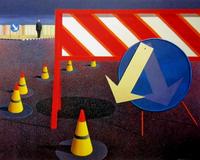
The Tilted Arrow
Jeffrey Smart
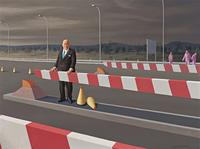
Entrance to the Autostrada
Jeffrey Smart
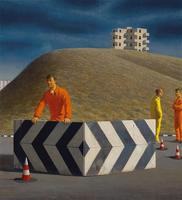
Near Pisa
Jeffrey Smart
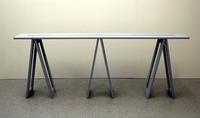
Portrait
Stanley Brouwn
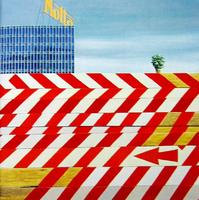
The Red Arrow II
Jeffrey Smart
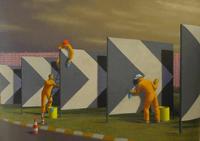
The Cleaners
Jeffrey Smart
Skaters
Jeffrey Smart
Trois
François Decq
Sussex Bypass
Edward Wadsworth
Landscape BB
Allan D'Arcangelo
Car Park at Night
Jeffrey Smart
Civitella
Jeffrey Smart
Saw Horse Piece
Gary Kuehn
Study for 'Car Park at Night'
Jeffrey Smart
Taxi Stand, Brisbane Art Gallery
Jeffrey Smart
Untitled (Bar)
Andre Cadere
First Landing Jump
Robert Rauschenberg
Radial Road
Jeffrey Smart
Garage Attendant
Jeffrey Smart
Taxi Stand
Jeffrey Smart