Kyiv Philistine
Analisi esperta di Kyiv Philistine di Fyodor Solntsev
Stile: Romanticism · Genere: sketch and study
Analysis of "Kyiv Philistine" by Fyodor Solntsev
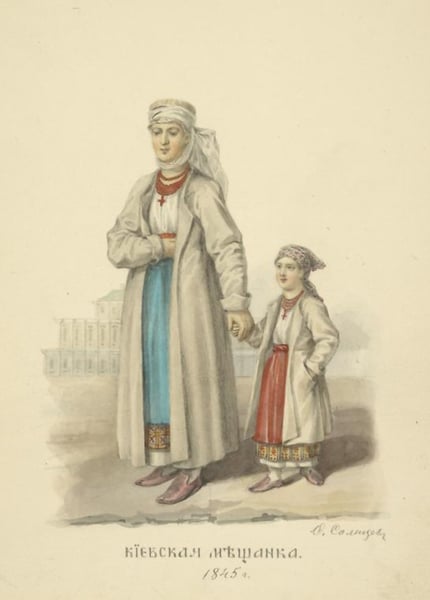
Fyodor Solntsev’s “Kyiv Philistine” is a remarkable example of how Romanticism’s fascination with national identity and local color could be expressed through the precise, ethnographic mode of the sketch and study. While Romanticism is often associated with dramatic landscapes or heroic historical scenes, Solntsev’s work channels the movement’s core ideal – the celebration of the unique spirit of a people – into a meticulous, almost documentary record of everyday costume and character.
Significance within Romanticism and its Period:
-
Ethnographic Romanticism: Solntsev was a key figure in the Russian Revival, commissioned to document the decorative arts and folk types of the Russian Empire. “Kyiv Philistine” transcends mere portraiture; it is a visual artifact that embodies Romantic nationalism. By focusing on a “philistine” – a common urban dweller of Kyiv – the artist elevates the anonymous, ordinary individual to a subject of historical and cultural importance. This aligns perfectly with Romanticism’s turn toward the “folk” as the authentic source of national identity.
-
The Study as a Romantic Gesture: The genre of “sketch and study” is often undervalued, but here it is integral to the work’s significance. The finished study suggests immediacy and faithfulness to the observed subject. In a period when official portraiture favored idealization, Solntsev’s approach – recording specific details of clothing, posture, and accessories – captures a raw, unvarnished truth. This commitment to direct observation echoes Romanticism’s rejection of Neoclassical formula in favor of sincere, personal experience.
-
Cultural Specificity as Romantic Subject: The depiction of a Kyiv philistine is not generic. The specific cut of the coat, the headgear, and the restrained demeanor speak to a local identity distinct from Moscow or St. Petersburg. At a time when the Russian Empire was expanding and consolidating its diverse cultures, Solntsev’s study functions as a visual archive of regional diversity. It preserves the “type” before it might be lost to modernization – a deeply Romantic impulse to freeze a vanishing past.
-
Influence on Later Realism: Solntsev’s studies, including this one, paved the way for the later 19th-century Russian Realists (e.g., the Peredvizhniki) by treating everyday people with dignity and precision. “Kyiv Philistine” stands at a crossroads: it is Romantic in its nationalist fervor, yet proto-Realist in its carefully observed details. This hybrid significance makes it a crucial work for understanding how Romantic idealism could be grounded in tangible, local truth.
In summary, “Kyiv Philistine” is not merely a preparatory sketch; it is a deliberate, sensitive portrait of a cultural archetype. It demonstrates that Romanticism’s search for the soul of a nation could be conducted with the quiet, steady hand of an ethnographer – making Solntsev’s study both a work of art and a historical document of enduring value.
Visivamente simili
20 opere con composizione e palette affini
Clothing woman from Kyiv Province
Fyodor Solntsev
Dress of the Kyivan girl
Fyodor Solntsev
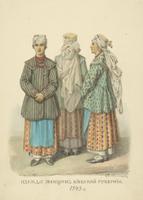
Clothing woman from Kyiv Province
Fyodor Solntsev
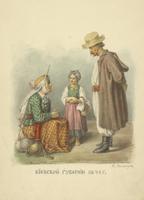
Kyiv province
Fyodor Solntsev
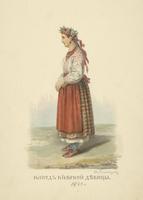
Dress of the Kyivan girl
Fyodor Solntsev
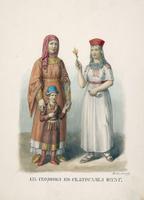
From Svyatoslav's snornik
Fyodor Solntsev
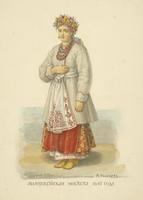
Little Russian bride
Fyodor Solntsev
Paganica costume. Province of Basilicata in the Kingdom of Naples
Michela De Vito
Tenderness
Sergey Solomko
Hide and Seek
Sergey Solomko
Study of a Standing Man and Child
Hendrick Avercamp
Blarney
Sergey Solomko
Physionomies Parisiennes: Petit Commerce. La Monnaie d'un Ballon
Paul Gavarni
Meeting
Sergey Solomko
Woman and child from Subiaco (23 august 1826)
Theodor Leopold Weller
Female costume of Villabadessa Albanian colony (Province of Teramo in the Kingdom of Naples)
Michela De Vito
Costume of Carafagreci (Province of Calabria in the Kingdom of Naples)
Michela De Vito
Varvara. Costume Design for Nikolai Ostrovsky's 'The Thunderstorm'
Boris Kustodiev
Idyll
Sergey Solomko
The scene with three figures in costumes
Nicholas Roerich