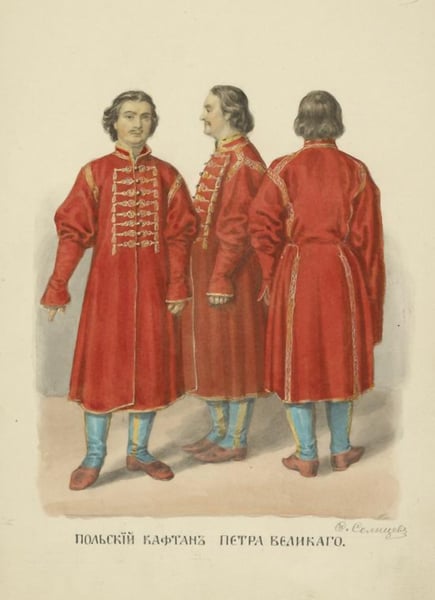
Polish coat of Peter the Great
Analisi esperta di Polish coat of Peter the Great di Fyodor Solntsev
Stile: Romanticism · Genere: sketch and study
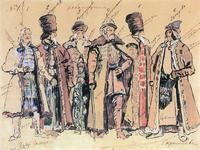
The "Polish coat of Peter the Great" by Fyodor Solntsev is a significant work within the Romanticism movement, specifically as a sketch and study that embodies the era’s fascination with national history, cultural identity, and the detailed documentation of artifacts.
Historical Context and Artistic Purpose:
Fyodor Solntsev (1801–1892) was a pivotal figure in 19th-century Russian art, renowned for his meticulous ethnographic and historical records. During the Romantic period, artists sought to capture the essence of national heritage, often turning to medieval and early modern relics as symbols of a shared past. Solntsev’s work was directly tied to this impulse; he was commissioned by the Russian government to document and preserve the material culture of the Russian Empire, including items like the "Polish coat of Peter the Great." This particular sketch and study exemplifies the Romantic artists’ role as historians and conservators, bridging art and scholarship.
Significance as a Sketch and Study:
The piece is not a polished, idealized painting but a careful étude — a working study that prioritizes exactness and detail over emotional drama. In Romanticism, such studies were valued for their authenticity and direct observation. Here, Solntsev captures the physical attributes of the coat (likely a type of kontusz or Polish-style garment worn by Peter I) with precision: folds, fabric texture, embroidery patterns, and structural seams. This forensic attention serves both artistic and antiquarian purposes. As a sketch, it reveals the artist’s process — how he examined the object in situ, perhaps in a palace collection or ecclesiastical vestry, and translated three-dimensional form into two-dimensional visual notation.
Cultural and Symbolic Weight:
The subject itself — a coat of Peter the Great — carries layered meaning. Peter was the architect of Russia’s Westernization, and his adoption of Polish-style clothing symbolized his pragmatic cultural borrowing. For a Romantic audience, this artifact was a tangible link to a transformative reign. Solntsev’s study strips away mythologizing and presents the object as a factual, almost scientific document. This aligns with Romanticism’s dual obsession with both the exotic (the Polish garment as a relic of a neighboring culture) and the authentic historical relic.
Contribution to Art History:
"Polish coat of Peter the Great" stands out because it transcends the typical Romantic emphasis on mood and sublime nature. Instead, it grounds Romantic ideals in material culture. Solntsev’s work directly influenced later Russian applied arts and historicist design, serving as a reference for painters, costume designers, and craftsmen. Its significance lies in its role as a visual archive — a blueprint for understanding how Romantic artists contributed to the preservation of national memory through exacting draftsmanship. The artwork is thus a testament to Romanticism’s lesser-discussed facet: the scholarly, conservationist impulse that treated even a single coat as a vessel for history.
Visivamente simili
20 opere con composizione e palette affini
From the wedding of Tsar Mikhail Fedorovich
Fyodor Solntsev
Silk robe of Tsar Ivan Vasilyevich IV
Fyodor Solntsev
People clothes the province of Kyiv
Fyodor Solntsev
Ladislaus II
Josef Kriehuber
Costumes and make-up to the tragedy of Pushkin's Boris Godunov
Kuzma Petrov-Vodkin
Sabolch, legendary Hungarian military leader
Josef Kriehuber
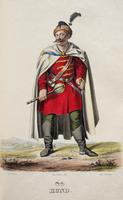
Kund, legendary Hungarian military leader
Josef Kriehuber
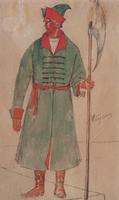
Costume design for Archer to the tragedy of Pushkin's Boris Godunov
Kuzma Petrov-Vodkin
József Katona, Hungarian writer
Miklos Barabas
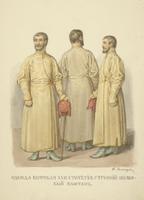
Mobleman Clothing of the XVII century. Morning silk kaftan
Fyodor Solntsev
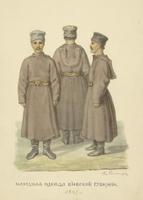
People clothes the province of Kyiv
Fyodor Solntsev
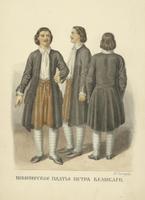
Skipper dress of Peter the Great
Fyodor Solntsev
Zoltan
Josef Kriehuber
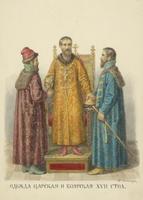
Royal and nobleman clothing of the XVII century
Fyodor Solntsev
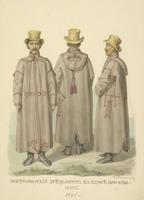
Burgher from Zhitomir in the cloak
Fyodor Solntsev

Andreas III (c.1265-1301), King on Hungary from 1290 to 1301
Josef Kriehuber
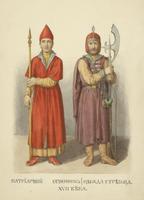
Patriarchal ognennik.Clothes of Archer.
Fyodor Solntsev
Part of a Series Chronicling the Uniforms of Napoleon's Grande Armée.
Carle Vernet
A young man in military uniform
Ilya Repin
Prince Golitsyn and the boyars
Konstantin Korovin