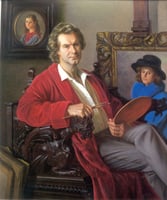
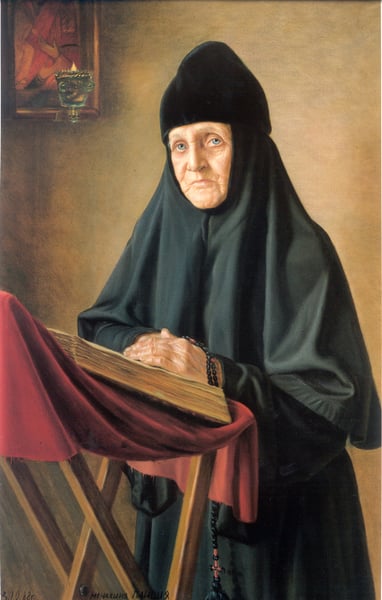
Analisi esperta di In the cell (Mother Paisija). Puhtitsky monastery di Alexander Shilov
Stile: Kitsch, Romanticism · Genere: portrait
Expert Art Historical Analysis
Artwork: In the cell (Mother Paisija). Puhtitsky monastery
Artist: Alexander Shilov
Style: Kitsch, Romanticism
Genre: Portrait
This portrait of Mother Paisija, a nun in the Puhtitsky monastery, exemplifies a provocative fusion of Romantic idealism and Kitsch sensibility—a combination that defines much of Alexander Shilov’s controversial oeuvre. Its significance lies in how it deliberately blurs the line between sincere devotional portraiture and mass-appeal sentimentality, making it a key case study in late-20th-century Russian academic painting.
Romanticism in Service of Spiritual Idealization
The Romantic element is most evident in the treatment of the sitter’s inner life. Mother Paisija is rendered with soft, diffuse lighting that isolates her face against a dark, simplified background—a classic Romantic trope used to evoke introspection and transcendental quietude. Her gaze is slightly averted, suggesting a soul turned away from worldly distractions, while the meticulous rendering of her monastic habit and the modest cell interior emphasizes a life of pious simplicity. The Romantic tradition of portraying artists, thinkers, or saints as solitary, emotionally charged figures is here transferred to an Orthodox nun, elevating her to a symbol of unwavering faith.
Kitsch as Democratized Devotion
What makes the work significant—and often contentious—is its deliberate embrace of Kitsch aesthetics. Shilov employs hyper-realistic detail (the texture of the fabric, the glint of a cross, the smoothness of aged skin) not for naturalistic documentation but for emotional manipulation. The composition is tightly cropped, the color palette warm and sentimental, and the sitter’s expression is carefully calibrated to evoke tenderness and pity. This is Kitsch in the sense defined by Clement Greenberg and later theorists: art that appropriates the emotional depth of Romanticism but flattens it into easily consumable, comforting piety. The portrait functions as a “sacred icon” for popular consumption, bypassing critical complexity in favor of immediate, uncomplicated reverence.
Significance within the Kitsch/Romanticism Dialogue
Shilov’s work stands at the crossroads of late Socialist Realism’s academic polish and post-Soviet commercial religious revival. In this portrait, the rigorous technique of 19th-century Romantic portraiture is subordinated to a kitschy, mass-media sensibility. The painting’s significance is not in breaking new formal ground, but in its cultural role: it offers a romanticized, accessible image of monastic life that resonates with audiences seeking spiritual authenticity in an age of secular uncertainty. Critics dismiss it as saccharine, but its very popularity underscores how Kitsch can repurpose Romantic ideals for a broad, emotionally hungry public. Thus, In the cell is a telling artifact of how high-art conventions are transformed into devotional commodities, challenging the boundary between sincere art and sentimental decoration.
Visivamente simili
20 opere con composizione e palette affini
Nun
Ilya Repin
Portrait of Yekaterina Kropotova
Vladimir Borovikovsky

Monjita
Julio Romero de Torres
Young Nun
Konstantin Makovsky
Inconsolable grief
Mariam Aslamazian
Abbess
Boris Kustodiev
Abbess
Boris Kustodiev
Portrait of S.M. Lukomskaya
Zinaida Serebriakova
Nun
Ilya Repin
Socializing
Reza Rahimi Lasko
Madre
José Garnelo
Portrait of the artist's grandmother Ashkhen
Ivan Aivazovsky
The old woman with a patterned headscarf
Vasily Surikov

Abbess
Boris Kustodiev
Beggar, Ninety Six Years Old
Vasily Vereshchagin
Virgin Annunciate
Antonello da Messina
Portrait of An Old Woman
Sebastiano del Piombo
Portrait of an old woman
Vasily Perov
Portrait of Archduchess Isabella Clara Eugenia, Regent of the Southern Netherlands (1566-1633), half-length, as a nun, in a painted oval
Jan van den Hoecke
Madre Maria Jeronima de la Fuente
Diego Velazquez