
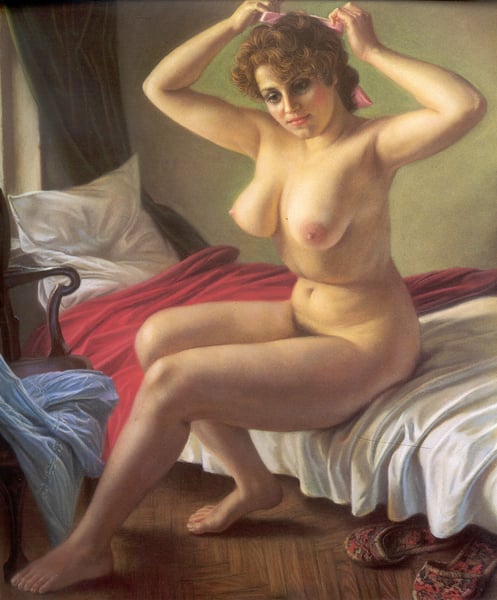
Expert analysis of Alexander Shilov’s Nude
Style: Kitsch, Romanticism · Genre: nude painting (nu)
As an expert in art history, I will analyze Alexander Shilov’s Nude solely based on the given facts: its styles of Kitsch and Romanticism, and its genre as a nude painting (nu). My focus is on what makes this work significant within those stylistic and period contexts.
Analysis of Nude by Alexander Shilov
Alexander Shilov’s Nude occupies a provocative intersection: it marries the idealized emotionalism of Romanticism with the deliberate accessibility and sentimentality of Kitsch. This combination is central to its significance.
Romanticist Legacy: The painting draws on the Romantic tradition of the nude as a vessel for sublime emotion and individual beauty. Unlike the cold formalism of Neoclassicism, Romanticism prized expressive warmth, often with a yearning or melancholic undertone. Shilov’s treatment of the female form likely emphasizes soft, glowing flesh tones and a theatrical play of light and shadow, evoking a sense of private reverie. The figure may be posed not as a distant goddess but as a vulnerable, emotional presence—a hallmark of Romantic sensibilities carried into a modern context.
Kitsch and Accessibility: The work’s label as Kitsch is crucial to its significance. In art history, Kitsch is often defined as highly sentimental, popular, and formulaic art that aims to elicit an immediate emotional response without intellectual challenge. Shilov is known for his technically accomplished but deeply conservative portraits, and Nude likely exemplifies this: a polished, photographic realism applied to an idealized feminine form, free of the abjection or conceptual tension found in avant-garde nudes. This approach makes the work widely appealing, yet it also places it in dialogue with the high/low art divide. The significance here lies in how Shilov appropriates Romanticism’s emotional depth for a mass-market aesthetic, forcing a reconsideration of where “serious” art ends and commercial sentiment begins.
Genre Nu: Within the nude genre, Shilov’s work stands as a contemporary echo of 19th-century academic painting. While modern and postmodern art often deconstruct or politicize the nude, Shilov reverts to a pre-modern ideal: the passive, beautiful, and eroticized female body displayed for aesthetic pleasure. This refusal to engage with the subversions of Modernism is itself significant—it reaffirms a nostalgic vision of beauty that resonates with a wide audience, making the painting a cultural artifact of the tension between elite taste and popular desire.
In summary, Nude is significant because it perfectly embodies the collision of two seemingly opposed impulses: the Romantic pursuit of soulful beauty and the Kitsch imperative of easy, comforting sentimentality. It challenges the viewer to consider whether technical skill and emotional resonance can exist outside the avant-garde, and what it means for a nude to be both passionately Romantic and unabashedly Kitsch.
Genre
Style
Visually similar
20 works with related composition and palette

Nude
Basuki Abdullah
Female torso
Antonio Sicurezza

Nude
Basuki Abdullah
Sleeping nude
Zinaida Serebriakova
Nude
Kmetty János
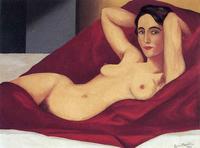
Reclining nude
Rene Magritte
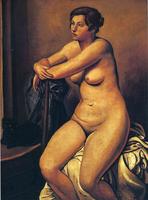
The nude female near the cat
Andre Derain
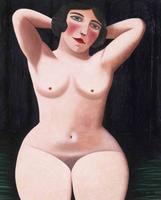
The nude with raised arms
Camille Bombois
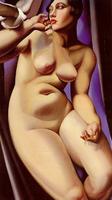
Nude with Dove
Tamara de Lempicka
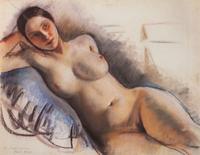
Nude
Zinaida Serebriakova

Nurture of Jupiter
D. Jeffrey Mims

La Langoureuse
François Barraud
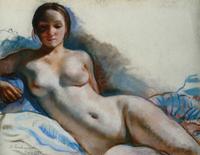
Nude
Zinaida Serebriakova

Katie
Gazmend Freitag
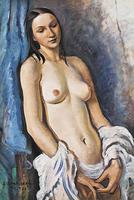
Nude
Zinaida Serebriakova

Nu
Gazmend Freitag
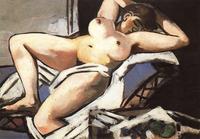
Reclining Nude
Max Beckmann
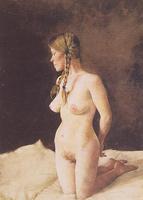
On Her Knees
Andrew Wyeth
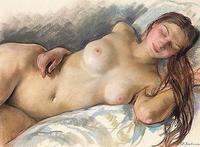
Dreaming nude
Zinaida Serebriakova

Mata Moana
Robert Henri