
Expert analysis of Mel Bochner’s Language Is Not Transparent
Style: Conceptual Art
Artwork: Language Is Not Transparent (1969–1970)
Artist: Mel Bochner
Style: Conceptual Art
Analysis
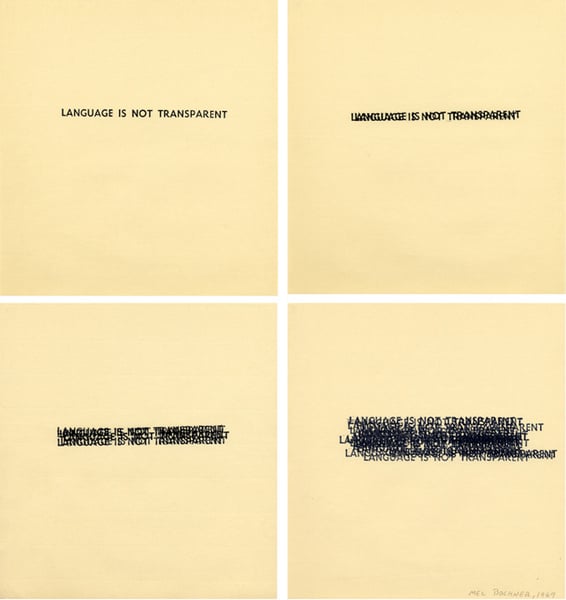
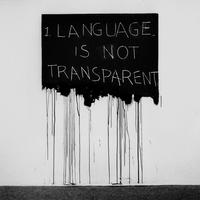
Mel Bochner’s Language Is Not Transparent is a landmark work within Conceptual Art, a movement that prioritized ideas over visual or material form. The piece typically consists of a wall text—often painted directly onto the gallery wall—in which the title phrase is repeated in a grid or list, sometimes with slight variations in capitalization, punctuation, or spacing. By presenting the statement as both the subject and the object of the work, Bochner directly confronts the viewer with the central thesis: language does not simply “carry” meaning without distortion or interference.
Significance within Conceptual Art:
-
Reflexivity and Self-Critique: The work exemplifies Conceptual Art’s tendency to turn its own medium into a question. Rather than using language to describe an external reality, Bochner makes the opacity of language itself the content. This self-referential loop is a hallmark of the movement and anticipates later investigations into text-based art and semiotics.
-
Dematerialization of the Art Object: The artwork exists not as a unique, salable object but as an idea enacted through a reproducible text. This aligns with Lucy Lippard’s concept of the “dematerialization of the art object,” a key feature of Conceptual practice. The viewer’s engagement is intellectual rather than perceptual.
-
Challenging Artistic Conventions: By writing directly on the wall—often in a straightforward, bureaucratic font—Bochner rejects traditional painterly or sculptural values. The work demands that the viewer read and think, not merely look. It questions the boundaries between art, language, and philosophy.
-
Influence on Later Text-Based Art: Language Is Not Transparent is a precursor to works by artists such as Joseph Kosuth (e.g., One and Three Chairs), Lawrence Weiner, and Jenny Holzer. It helped establish the premise that language could be a primary artistic material, not just a supplementary label or title.
In summary, Bochner’s piece is significant for its radical assertion that meaning is never pure or direct—an insight that resonates far beyond the gallery, influencing fields from literary theory to media studies. It remains a powerful statement on the mediated nature of all communication.
Style
Tags
Visually similar
20 works with related composition and palette
Manifesto For Maintenance Art 1969!
Mierle Laderman Ukeles
Paintings
Marcel Broodthaers
Auto-nomo (I Vedenti)
Alighiero Boetti
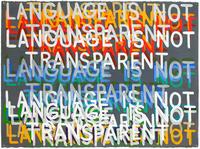
Language Is Not Transparent
Mel Bochner
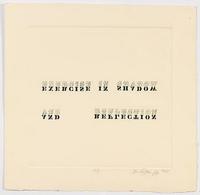
Exercise in Shadow and Reflection
Luis Camnitzer
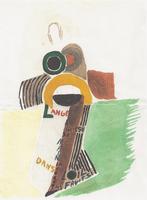
Robe Poème, L’Ange a Glissé…
Sonia Delaunay
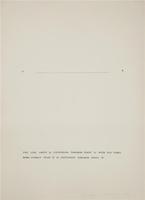
Untitled (The Line Above)
Douglas Huebler
Untitled
Ion Bitzan
Edges
Richard Tuttle
Autoritratto 5
Irma Blank
Brouwn Lemonspot
Stanley Brouwn
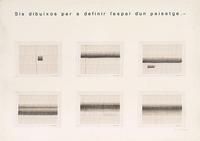
Six Moments to Define Space in a Landscape
Joan Hernandez Pijuan
Original Fibonacci
Jennifer Bartlett
Untitled (Toquinho)
Mira Schendel
Tractatus Logico Catalogicus - Art Or the Art of Selling
Marcel Broodthaers
Déka 28
John Cage
Lable 5-8
Richard Tuttle
Passport
Carl Andre
Language Is Not Transparent
Mel Bochner
A page from Abracadabra 3
Pavlo Makov