Expertenanalyse zu Andy Warhols Turtle
Stil: Pop Art · Genre: animal painting
Expert Analysis: Turtle by Andy Warhol
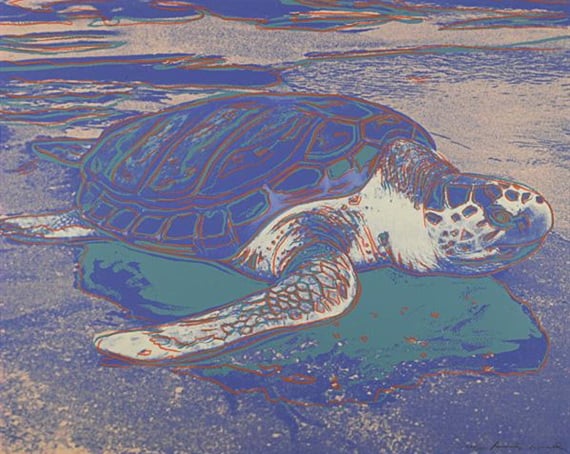
Andy Warhol’s Turtle exemplifies the core principles of Pop Art by transforming a humble, organic subject into a bold, graphic icon. As an animal painting within Warhol’s oeuvre, it shares the same conceptual framework as his more famous animal works—such as the cow wallpaper or the Endangered Species series—but distills the animal into a pure Pop image.
Significance within Pop Art
Warhol’s Turtle is significant for the way it applies the vocabulary of mass production to a natural subject. The painting strips the turtle of any naturalistic detail or habitat, flattening it into a high-contrast, screenprinted silhouette. The use of artificial, saturated colors (typical of Warhol’s palette) divorces the animal from reality, making it feel more like a commercial logo than a living creature. This process—mechanized, reproducible, and deliberately impersonal—is Warhol’s commentary on how modern media and consumer culture simplify and commodify even the natural world.
Stylistic Conventions
- Flatness and Graphic Line: The turtle is rendered with hard, clean edges and minimal shading, emphasizing shape over volume. This approach echoes the bold simplicity of advertising and comic strips.
- Color as Statement: Warhol’s choice of non-naturalistic colors (e.g., hot pink, electric blue, or high-contrast black-and-white) removes any sense of realism and instead foregrounds surface and affect. The turtle becomes a vehicle for pure visual impact.
- Seriality and Repetition: Though this single work is a standalone painting, Warhol’s typical practice of repeating an image multiple times (as in his Campbell’s Soup Cans or Marilyn Diptychs) suggests that Turtle could have been part of a larger series, reinforcing the idea that any subject—even a turtle—can be endlessly multiplied and consumed as an image.
Placement in Warhol’s Career
Turtle belongs to Warhol’s broader exploration of animals as ready-made pop icons. Unlike earlier painters who depicted animals with sentimentality or naturalism, Warhol treats the turtle with the same cool detachment he applied to celebrities, soup cans, or disasters. By elevating a slow, unassuming reptile to the realm of high art, he questions the very distinction between “important” and “trivial” subjects—a hallmark of Pop Art’s democratic (and ironic) gaze.
Conclusion
The work’s significance lies in its ability to make an ordinary animal extraordinary through the lens of Pop Art’s commercial aesthetics. Turtle is not a study of nature but a reflection on how images are manufactured, consumed, and stripped of meaning in a media-saturated world. Warhol’s turtle, frozen in vivid, artificial color, becomes an icon of Pop’s central paradox: the more we look at it, the less we see a turtle, and the more we see an image of an image.
Visuell ähnlich
20 Werke mit ähnlicher Komposition und Farbpalette
The Turtle Pound
Winslow Homer
Bahama Cove
Albert Bierstadt
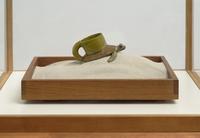
Blind Sea Turtle Cup
Kenneth Price
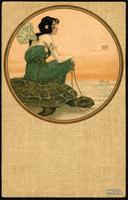
Fables
Raphael Kirchner
Goan Beach
John Miller
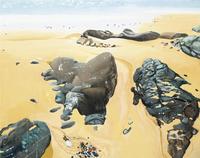
Marée Basse II (Rochers)
Gilles Aillaud
Cliffs and Sea
Maxime Maufra
Antakya-Istanbul-Antakya XXXIV
Artin Demirci
Iona
Samuel Peploe
Tresco
John Miller
Giant's tomb
Nicholas Roerich
Seashore at Audresselles
Carolus-Duran
Marée Basse (courants II)
Gilles Aillaud
Vuoristoa
Tove Jansson
Otaries dans l'eau
Gilles Aillaud
Duration Piece #12, Venice, California - Plum Island, (Newburyport) Massachusettes
Douglas Huebler
Iona Landscape
Samuel Peploe
Pines at Rafina
Konstantinos Maleas
Iona
Samuel Peploe
Marina
Kimon Loghi