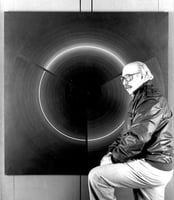
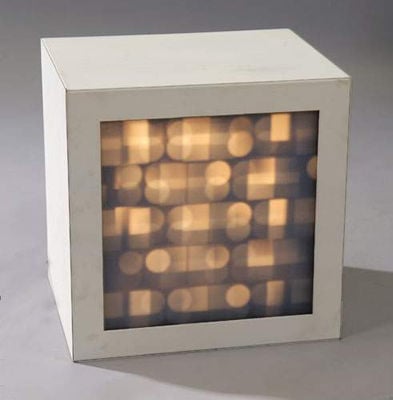
Espace cinétique
Экспертный разбор работы «Espace cinétique» художника Horacio Garcia-Rossi
Стиль: Kinetic Art · Жанр: installation
Expert Analysis of "Espace cinétique" by Horacio Garcia-Rossi
Horacio Garcia-Rossi’s "Espace cinétique" is a landmark installation within the Kinetic Art movement, exemplifying the radical shift from passive observation to active, embodied experience that defined the genre in the 1960s. As a member of the influential Groupe de Recherche d’Art Visuel (GRAV), Garcia-Rossi championed art that engaged the viewer physically, psychologically, and temporally.
Significance within Kinetic Art:
-
Breaking the Static Frame: Unlike earlier Op Art or static painting, "Espace cinétique" is an installation—a three-dimensional environment that envelops the spectator. It transforms the gallery into a dynamic, participatory space where movement is not merely depicted but actually generated by motors, light, or the viewer’s own motion. This aligns with Kinetic Art’s core ambition to dissolve the boundary between artwork and audience.
-
Real, Not Illusory, Motion: Garcia-Rossi uses real kinetic elements (often rotating metallic discs, vibrating surfaces, or shifting light patterns) to create optical and proprioceptive effects. The work’s title—“Kinetic Space”—underscores the artist’s intention to make the entire spatial field a living, changing entity. This was a direct challenge to traditional sculpture’s fixed point of view, instead offering a sequence of shifting perceptions.
-
GRAV’s Collective Legacy: Garcia-Rossi was central to GRAV’s mission of creating “laboratory” environments that demystified art and encouraged collective participation. "Espace cinétique" embodies this ideal: it is an anti-contemplative work meant to be walked through, touched, and experienced over time, reflecting the group’s emphasis on l’art en mouvement (art in movement) as a social and perceptual tool.
-
Pioneering Interactivity: Long before digital interactive art, "Espace cinétique" required the spectator to become a “mobile participant.” The work’s significance lies in how it predates later installation art and relational aesthetics, using mechanical means to investigate perception, time, and the instability of visual reality—hallmarks of the most advanced kinetic practice of its era.
In summary, "Espace cinétique" is significant because it redefines art as an experiential system rather than an object, making Garcia-Rossi a key figure in the move from modernist autonomy to postmodern, participatory environments.
Визуально похожие
20 работ с близкой композицией и палитрой
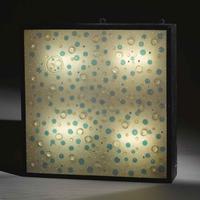
Reloj espacial
Gyula Kosice
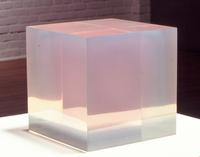
Pink Blue Cube
Peter Alexander
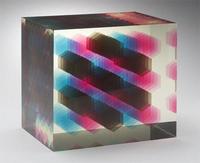
Opal
Norman Zammitt

Stained glass composition VIII
Theo van Doesburg
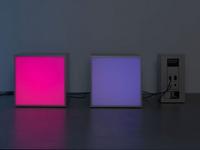
Aluminium Double
Angela Bulloch
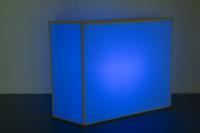
Lost space
Guy Mees

Orange Sphere
Peter Alexander
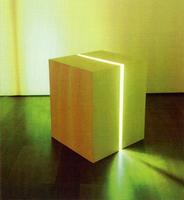
Verde
Lygia Pape
Cartones cambiables
Julio Le Parc

Spence
Peter Alexander
Untitled
Larry Bell
Between Blue
James Turrell
Couleurs en Diffusion B
Gregorio Vardanega

Progression of 8 Perverted Pixels
Angela Bulloch
Mana
Doug Ohlson
Untitled
Ettore Spalletti

Fundamental Three: ROYW
Angela Bulloch
Cube with Ambigous Space
Jesus Rafael Soto
DIN. GF 100
Vladimir Bonacic
Untitled
John McCracken