My Very Own Street, Sablet
Analisi esperta di My Very Own Street, Sablet di Fred Yates
Stile: Naïve Art (Primitivism) · Genere: cityscape
Expert Analysis of "My Very Own Street, Sablet" by Fred Yates
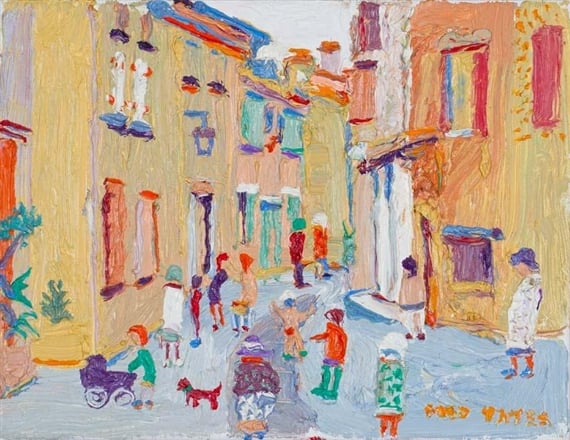
Fred Yates’s My Very Own Street, Sablet exemplifies the core principles of Naïve Art (Primitivism) through its unpretentious, emotionally direct representation of a cityscape. Painted in the distinctive style that defines Yates’s later work, this piece captures a sun-drenched street in the Provençal village of Sablet—a location the artist called home for many years.
Significance within Naïve Art and Primitivism
Yates is celebrated for his ability to distill complex urban scenes into simplified, almost childlike forms that radiate a sense of personal ownership and joy. The title itself—“My Very Own Street”—is a hallmark of the naïve approach: it claims an intimate, unmediated connection between the artist and the subject, rejecting the distanced, analytical perspective of academic painting.
In this work, Yates employs several conventions typical of Primitivism:
- Flat, unmodulated color areas that ignore traditional modeling or chiaroscuro, creating a vibrant, tapestry-like surface.
- Intuitive perspective where spatial depth is often suggested through overlapping and size differences rather than mathematical vanishing points, giving the street a slightly tilted, dreamlike quality.
- Celebration of everyday life—the scene likely includes ordinary details: shuttered windows, a winding road, local figures, and the intense southern light that drenches the landscape. This focus on the humble, the local, and the personal echoes the naïve artist’s rejection of grand historical or mythological subjects.
What Makes It Significant
Yates’s work stands out within the naïve tradition for its deliberate restraint and emotional honesty. Unlike some naïve artists whose work can appear merely decorative or quaint, Yates infuses My Very Own Street, Sablet with a heartfelt authenticity. The painting does not attempt to impress with technical bravura; instead, it invites the viewer into a specific, cherished place—a street that the artist truly felt was his own.
The significance also lies in how Yates transforms a provincial setting into a universal symbol of belonging. In the context of mid-to-late 20th-century art, when abstraction and conceptualism dominated, Yates’s unwavering commitment to representational, accessible imagery was a quiet but powerful assertion that beauty, memory, and place still mattered. His cityscape in Sablet is not merely a record of a location, but a testament to the idea that art can be both simple and profound, and that the most ordinary street, seen through loving eyes, becomes extraordinary.
Genere
Visivamente simili
20 opere con composizione e palette affini
Collioure street
Henri Martin
A Street in Bastia
Auguste Herbin
Pons, Charente-Maritime
Albert Marquet
Houses for Gigouzac
Henri Martin
Landscape in South of France
Lucian Grigorescu
Landscape from Saint Tropez
Nicolae Darascu
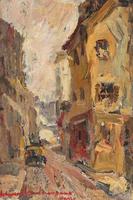
Street in Montmartre
Rudolf Schweitzer-Cumpana
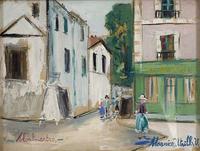
"Belle Gabrielle"
Maurice Utrillo
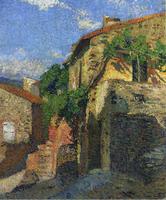
Houses at Collioure
Henri Martin
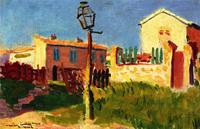
Street Lamp, Arcueil
Albert Marquet
Street in Moret Sur Loing
Alfred Sisley
Farm Courtyard
Pierre-Auguste Renoir
Maison À Toulouse
Henri Matisse
Damiette Street in Sannois
Maurice Utrillo
Tile Roofs
Horia Bernea
Mont-Cenis street
Maurice Utrillo
Collioure. Street with the palm
Zinaida Serebriakova
Street of Segovia
Tarsila do Amaral
Design for the opera by Wolfgang Amadeus Mozart, 'Don Giovanni'
Pyotr Konchalovsky
Italian Street
Joaquín Sorolla