
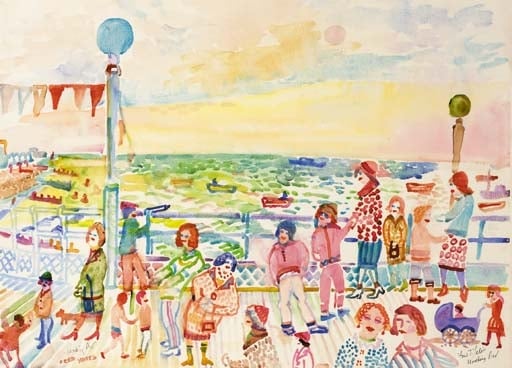
Worthing Pier
Analisi esperta di Worthing Pier di Fred Yates
Stile: Naïve Art (Primitivism) · Genere: genre painting
Expert Analysis of "Worthing Pier" by Fred Yates
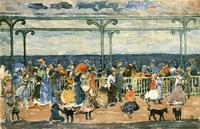
Fred Yates’ Worthing Pier is a vibrant example of Naïve Art (also called Primitivism), a style that deliberately rejects academic conventions in favor of a seemingly untutored, direct approach. Painted within the genre of everyday life (genre painting), the work captures a quintessentially British seaside scene with a freshness that elevates the ordinary into something joyful and memorable.
Significance within Naïve Art
What makes Worthing Pier significant is its embodiment of the core Naïve Art principles: bold, unmodulated color; simplified, often flattened forms; and a charming disregard for traditional perspective or anatomical precision. Yates employs a high-key palette of sky blues, sandy yellows, and bright whites. The pier itself is rendered as a series of crisp, geometric shapes that march confidently across the canvas, while figures are reduced to bright, gestural dabs of paint—suggesting bustling holidaymakers without laboring over detail. This “childlike” clarity is not a lack of skill but a purposeful choice to express emotion and immediacy over illusionistic depth.
Genre Painting and the “Everyday”
As a genre painting, Worthing Pier documents the simple pleasure of a day at the coast. Yates, a former teacher who turned to painting full-time in his forties, spent much of his career in British seaside towns. His work celebrates the democratic, unpretentious leisure of beach huts, promenades, and piers. In this piece, the pier functions as both a physical structure and a symbol of communal enjoyment. The emphasis is on atmosphere—the warmth of sunlight, the movement of crowds, the crisp sea air—rather than narrative or moral lesson. This focus on pure, uncomplicated happiness is rare in modern art, which often leans toward irony or critique.
Yates’ Distinctive Voice
While many naïve artists focus on rural or nostalgic themes, Yates brought a distinctly urban/suburban coastal energy to the style. His brushwork is energetic and painterly, avoiding the overly polished flatness that can make some naïve work feel static. The sky in Worthing Pier pulses with bands of color, and the water is suggested with short, lively strokes. This marrying of naïve simplicity with a lively, almost Impressionistic handling of light and movement gives his work a unique place—it is naïve in its outlook but sophisticated in its optical vitality.
In summary, Worthing Pier matters because it distills the essence of British seaside culture through the lens of Naïve Art, proving that directness and joy can be as artistically powerful as complexity and critique. It invites viewers to see the world with fresh eyes, celebrating the beauty of the everyday with infectious spontaneity.
Genere
Visivamente simili
20 opere con composizione e palette affini
Brighton Pier
Fred Yates
On the Promenade
Fred Yates
St. Malo No. 2
Maurice Prendergast
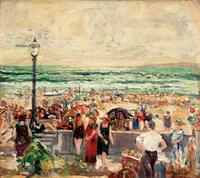
Holiday, Mission Beach
Charles Reiffel
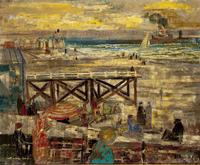
The Beach of Le Havre
Emilio Grau Sala
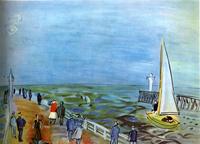
The sea in Deauville
Raoul Dufy
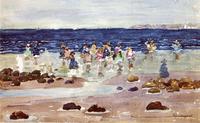
Low Tide
Maurice Prendergast
Low Tide
Maurice Prendergast
Brighton, East Sussex, from the West Pier
James Webb
Fishermen
Raoul Dufy
The Beach at Fécamp
Albert Marquet
July, the Seaside
L. S. Lowry
The Shape Of Things To Come
Jack Vettriano
San Lorenzo beach, Gijon, Asturias, Spain
Rubén de Luis
Czene Béla. Keszthelyi Moló 1963
Czene Béla
The Fourth of July by the Sea
Henri-Edmond Cross
The Bandstand
William James Glackens
The Fishermen
Raoul Dufy
Long Beach
Maurice Prendergast
Promenade at Nantasket
Maurice Prendergast