Tsuguharu Foujita sanatçısının Jeune femme assise eseri hakkında uzman analizi
Tarz: Expressionism · Tür: genre painting
Expert Art Historical Analysis: "Jeune femme assise" by Tsuguharu Foujita
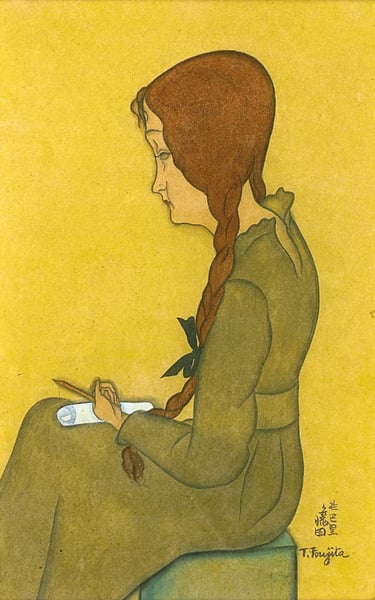
Tsuguharu Foujita’s "Jeune femme assise" (Seated Young Woman) occupies a distinctive position within early 20th-century Expressionism, where the artist synthesizes his Japanese heritage with Western modernist tendencies. While the work is classified as a genre painting—depicting an everyday figure—its significance lies in how Foujita transforms a simple seated pose into a nuanced study of mood, materiality, and cross-cultural identity.
Expressionist Inflection Through Tonal Restraint
Unlike the bold, often jarring color palettes associated with German Expressionism, Foujita’s Expressionism is characteristically subdued. His handling of the seated young woman relies on subtle shifts in muted tones—ivory whites, pale ochres, and soft grays—that evoke an atmosphere of quiet introspection. The figure’s slightly elongated proportions and simplified facial features (a hallmark of Foujita’s style) heighten the emotional resonance without resorting to dramatic distortion. This restraint aligns with the Expressionist goal of conveying inner experience, but does so through Eastern sensibility: economy of line, negative space, and a nearly porcelain-like surface finish.
Genre as a Vehicle for Modernity
The genre painting tradition typically records ordinary life, but Foujita elevates it by injecting an enigmatic stillness. The young woman’s seated posture—neither passive nor active—suggests a moment suspended between action and reflection. Her direct, yet unreadable gaze engages the viewer while maintaining psychological distance. This ambiguity is a hallmark of Foujita’s modernism: he uses a conventional subject (a seated woman) to explore alienation and calm in an era of rapid change. The painting thus comments on the universal human condition through a specifically urban, cosmopolitan lens—Foujita’s Paris of the 1920s.
Technical and Material Signature
Foujita’s treatment of the figure’s skin and clothing displays his renowned mastery of oil paint thinned to a luminous, matte finish—reminiscent of Japanese ink and mineral pigments. The delicate, almost calligraphic outlines define form without heavy modeling, creating a flattened pictorial space that bridges ukiyo-e woodblock prints and Post-Impressionist flatness. This technical fusion marks a critical moment when a non-Western artist reinterprets Expressionism from within, expanding its vocabulary beyond European paradigms.
Significance Within Expressionism and Global Art
"Jeune femme assise" is significant as an example of how Expressionism transcended its Germanic origins to become a truly international language. Foujita’s work challenges the notion that Expressionism must be loud or overtly emotional; instead, he proves that quiet containment can be equally expressive. The painting stands as a testament to the artist’s ability to navigate between cultures—retaining the introspective calm of Japanese aesthetics while fully engaging with Western modernity. In doing so, Foujita helped redefine genre painting not as a record of the ordinary, but as a profound meditation on presence, perception, and the subtle power of stillness.
Görsel olarak benzer
İlişkili kompozisyon ve renk paletine sahip 20 eser
Portrait of Ann (with Plait and Black Jumper)
L. S. Lowry
Girl with Braid
Tsuguharu Foujita
Melle. Rita Sablan-Diaz. Chamorro De Guam
Paul Jacoulet
Illustration from In Childhoods Country (Moulton)
Ethel Reed
Miss Eliana
Paul Jacoulet
La Dessinatrice
Mily Possoz
A Saint Lazare, Song Title
Henri de Toulouse-Lautrec
Dos niñas en la calle
Joy Hester
Portrait of K. Lancere
Zinaida Serebriakova
Lycee Racine - Fete du 8 Juin 1902
Theophile Steinlen
A Girl with a Doll
Morteza Katouzian
Self Portrait
Gwen John
Portrait of Olga
Pablo Picasso
Dorothy Barnard
John Singer Sargent
Head of a girl
Jan Mankes
YOUNG GIRL OF ZSDJAR IN SUNDAYCLOTHES
Marianne Stokes
Untitled
Antonio Bueno
Mulata
Alberto da Veiga Guignard
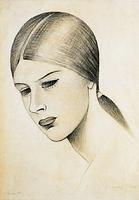
Portrait of Ann II
L. S. Lowry
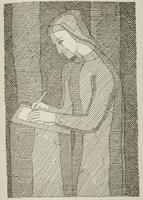
Writing Dante. Illustration to Dante Alighieri's Book 'Vita Nova'
Hryhorii Havrylenko