Music's allegory
Expertenanalyse zu Vieira Portuenses Music's allegory
Stil: Neoclassicism · Genre: allegorical painting
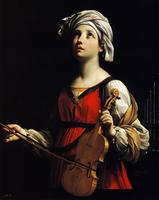
Analysis of "Music's Allegory" by Vieira Portuense
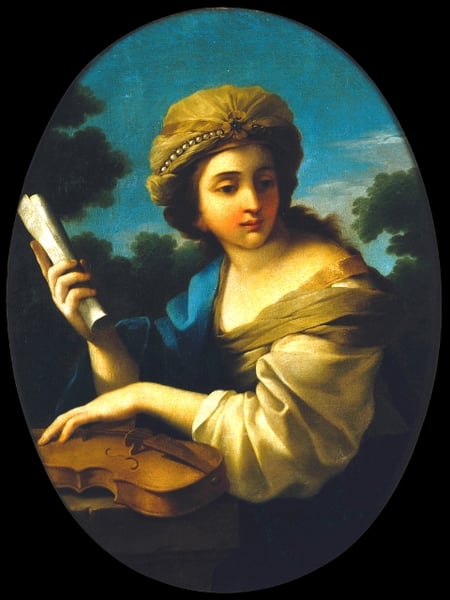
This work stands as a compelling example of Neoclassical allegorical painting, a genre that sought to revive the clarity, order, and moral seriousness of classical antiquity. Vieira Portuense, a leading Portuguese Neoclassical painter, here employs personification—a central device of allegory—to embody the abstract concept of Music. The significance of this artwork lies in its dual role: it both exemplifies the international Neoclassical idiom and reflects a distinctly Portuguese engagement with the Enlightenment ideals of reason and harmony.
As a Neoclassical work, "Music's Allegory" rejects the playful excesses of the Rococo in favor of balanced composition, idealized forms, and a restrained palette. The allegorical figure of Music is likely depicted with classical attributes—such as a lyre, scroll, or musical instruments—draped in flowing robes reminiscent of ancient Greek or Roman statuary. This use of classical iconography ties the universal power of music to the timeless values of order and civilization that Neoclassicism championed.
The painting’s broader significance is rooted in Portuense’s career. Trained in Rome and influenced by the major Neoclassical masters (such as Mengs and David), he returned to Portugal to become a pivotal figure in introducing and popularizing the style there. "Music's Allegory" thus functions as a cultural bridge: it translates the rigorous, didactic spirit of continental Neoclassicism into a Portuguese context, asserting that the arts, like music itself, are a civilizing force. In this way, the artwork is not merely a decorative personification but a manifesto of Enlightenment values—a celebration of reason, beauty, and the elevating power of human creativity.
Visuell ähnlich
20 Werke mit ähnlicher Komposition und Farbpalette
Sainte Cécile
Giovanni Francesco Romanelli
An allegory of vanity
Ginevra Cantofoli
Allegory of Music
Elisabetta Sirani

Portrait of a Lady
Willem Wissing
Melpomene, The Muse of Tragedy
Elisabetta Sirani
Saint Catherine of Alexandria reading
Onorio Marinari
BILDNIS EINER SIBYLLE
Lorenzo Pasinelli
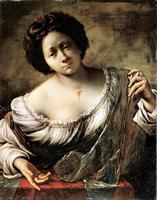
Santa Cristina
Francesco Cairo
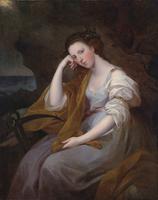
Portrait of Louisa Leveson Gower as Spes (Goddess of Hope)
Angelica Kauffman
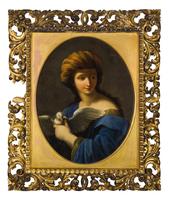
Allegoria dell'Innocenza
Giovanni Francesco Romanelli
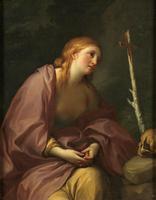
Penitent Magdalen
Anton Raphael Mengs
Erminia, Princess of Antiochia
Mattia Preti
Portrait of Mme Latouce
Angelica Kauffman
Lady Frances Greville (1744–1825), Lady Harpur
Angelica Kauffman
Virginia da Vezzo, the Artist's Wife, as the Magdalen
Simon Vouet
Saint Barbara
Parmigianino
Sibila Eritrea
Lorenzo Pasinelli
maddalena
Domenico Fiasella
Portrait of Mrs. Gedicke
Carl Joseph Begas
St Cecilia
Guido Reni