
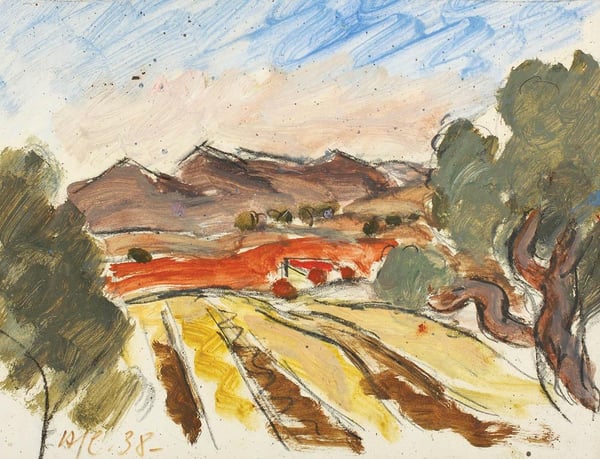
Henri Catargi sanatçısının Provensal Landscape eseri hakkında uzman analizi
Tarz: Impressionism · Tür: landscape
Expert Analysis of "Provensal Landscape" by Henri Catargi
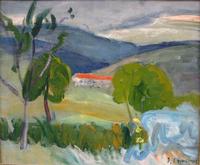
Henri Catargi’s Provensal Landscape embodies the core tenets of Impressionism while offering a distinctive meditation on the light and atmosphere of southern France. Though Catargi is a lesser-known figure in the movement, this work demonstrates a masterful command of the Impressionist idiom—rapid, broken brushwork, a high-key palette, and an emphasis on capturing a fleeting moment.
Significance within Impressionism and the Provençal Tradition
-
Luminosity and Color – True to Impressionist practice, Catargi builds his scene from pure, unmixed pigments. The canvas is saturated with warm ochres, soft lavenders, and brilliant greens, suggesting the intense sunlight of Provence. Rather than delineating forms with hard outlines, he relies on chromatic contrasts to define the landscape—a hallmark of the style pioneered by Monet and Renoir.
-
Atmospheric Transience – The painting’s subject is not a specific landmark but the sensation of the Provençal spring or summer. Catargi’s loose, dappled brushwork captures the shimmer of heat and the play of shadows across fields and hills. This prioritization of optical experience over topographic accuracy aligns with Impressionism’s revolutionary goal: to render the artist’s perceptual moment, not a static record.
-
Continuation of Post‑Impressionist Vision – While firmly rooted in Impressionism, Catargi’s composition reveals an awareness of Cézanne’s Provençal landscapes. The strong horizontal bands (foreground, middle ground, sky) and the geometric ordering of trees and rooftops hint at a more structured sense of form, bridging the early Impressionist concern for light with a later push toward volumetric solidity.
-
Cultural and Regional Identity – Provence held a special allure for Impressionist and Post‑Impressionist artists (van Gogh, Cézanne, Renoir). Catargi, a Romanian-born painter who studied in Paris, absorbs this tradition and adds his own lyrical sensibility. His work serves as a testament to the enduring influence of French regional landscape painting, carrying Impressionism into the early‑20th‑century.
In sum, Provensal Landscape is significant not only as a refined example of Impressionist technique—vibrant palette, broken color, atmospheric capture—but also as a dialogue between the movement’s founding principles and the unique character of the Midi. It rewards the viewer with a vivid, sensory immersion into a sun‑drenched Provençal afternoon.
Görsel olarak benzer
İlişkili kompozisyon ve renk paletine sahip 20 eser
Egry József, Badacsony 1949
Egry József
Egry József, Badacsony, . ,
Egry József
Landscape at Vence
Christopher Wood
Egry József, Badacsony,..
Egry József
View of a Village with Red Roofs
Maurice de Vlaminck
Landscape
Konstantinos Parthenis
Landscape at Aix, France
Matthew Smith
Galilee
Jacques Sterenberg
Grand Paysage Aux Arbres
Henri Matisse
Czóbel Béla, Tájkép
Bela Czobel
Landscape of the Malvern Distance
Paul Nash
Mongolian Landscape
Fujishima Takeji
Egry József, Virágzó Barackfák
Egry József
Blauer Berg
Alexej von Jawlensky
Spring Dawn on the South Bank of river
Guan Zilan
Mont Sainte-Victoire Seen from les Lauves
Paul Cezanne
Paysage Au Grand Arbre
Bela Czobel
Landscape
Alekos Kontopoulos
Three Cypress Trees
Alexis Gritchenko
Red Rooftops near Marnat
Émilie Charmy