Analisi esperta di 18.9.56 di Julius Bissier
Stile: Art Informel · Genere: abstract
Expert Analysis: "18.9.56" by Julius Bissier
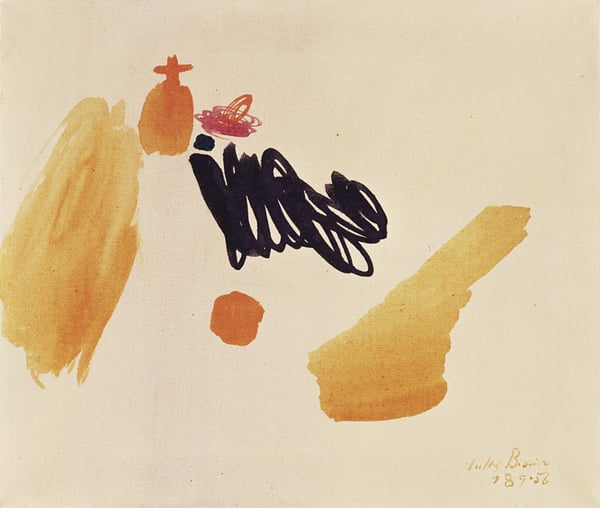
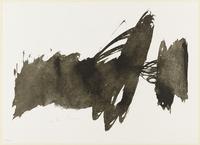
Within the provocative and often raw landscape of Art Informel, Julius Bissier’s "18.9.56" stands as a testament to the movement's quieter, more meditative possibilities. Art Informel—an umbrella for post-war European abstraction that championed gesture, spontaneity, and the 'formless'—typically resists clear imagery. Bissier, however, refined these impulses into a deeply personal, calligraphic language.
The title itself is the work’s first philosophical gesture: by naming the piece after its date of creation (18 September 1956), Bissier rejects a descriptive title in favor of a temporal marker. This aligns with the Art Informel ethos of the artwork as a document of process and psychic flow rather than a representation of external reality.
What makes "18.9.56" significant is its synthesis of Eastern restraint and Western existential gesture. Where many of his Informel contemporaries—such as Wols or Jean Fautrier—embraced aggression, dense impasto, or tragic anxiety, Bissier distills his marks into ethereal, floating forms. The composition (likely an ink-wash or thinly brushed oil on a small, intimate scale) relies on economy: a few delicate lines and washes suggest an internal landscape, suspended between presence and absence. This reflects the movement's deeper roots in Zen philosophy and the idea of sumi-e—a single stroke capturing the essence of a moment.
In the context of the 1950s, when Europe was grappling with the trauma of war through violent, anti-compositional art, "18.9.56" offers a counter-narrative: that abstraction can also be lyrical, serene, and psychologically open. Bissier’s work bridges the gap between the explosive energy of Tachisme and the refined minimalism of later post-painterly abstraction, making him a crucial, if understated, figure in the evolution of European modernism. This piece is not significant for its scale or bombast, but for its demonstration that in Art Informel, a whisper can be as powerful as a shout.
Genere
Stile
Visivamente simili
20 opere con composizione e palette affini
3.9.56 II
Julius Bissier
Layer of Earth
Kazuo Shiraga
Two Compositions
Yuri Zlotnikov
Number 13
James Brooks
Breathing
Fons Heijnsbroek
Untitled
Gerard Schneider
No-chaos - a visual comment on Albert de Wilde
Fons Heijnsbroek
Rythm. Space. People
Yuri Zlotnikov
Farbspiele
Ernst Wilhelm Nay
75 Stones
John Cage
Untitled
Gerard Schneider
Schwarz vor Grau und Gelb
Fritz Winter
Untitled
Yuri Zlotnikov
Blue-03
Georgia O'Keeffe
Untitled
Julius Bissier
Fictitious Blank #2841W20
SHIH,SIAO-MO
Untitled
Samuel Buri
Univers lyrique
PR-Monsar
Untitled
Ray Parker
Untitled
Yuri Zlotnikov