
Analisi esperta di Family Tree di Ozdemir Atlan
Stile: Art Informel · Genere: abstract
Expert Analysis of "Family Tree" by Ozdemir Atlan (Art Informel, Abstract Genre)
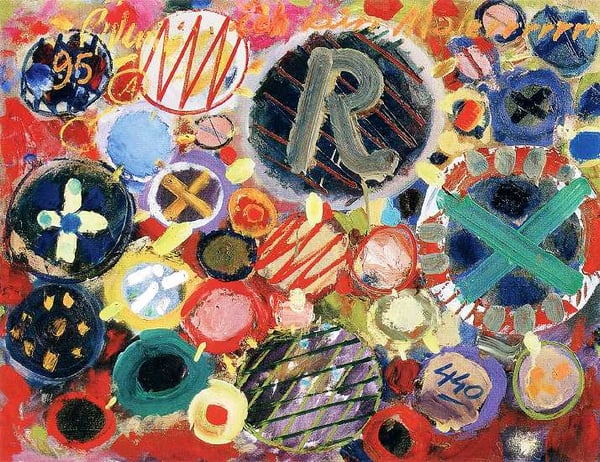
Ozdemir Atlan’s Family Tree stands as a compelling exemplar of Art Informel, the mid-20th-century European movement that rejected geometric abstraction in favor of raw, gestural, and emotionally charged form. Painted in Atlan’s signature style—where earthy pigments and bold, black, calligraphic contours dominate—the work transforms the titular biological metaphor into a visceral, existential diagram.
Significance within Art Informel:
Art Informel, emerging in post-World War II France, sought to bypass conscious composition and instead channel the artist’s spontaneous, often tormented inner life. Family Tree embodies this ethos through its deliberate “anti-form”: the branches are not drawn with naturalistic precision but erupt as jagged, slashing strokes that seem to grow organically from the canvas itself. Atlan’s use of dense, textured paint (often mixed with sand or gravel) gives the surface a tactile, almost scarred quality—a hallmark of the matière (material) emphasis in informel.
The title, Family Tree, introduces a conceptual tension. Rather than celebrating lineage or stability, Atlan’s abstracted arboreal form suggests fragmentation and struggle. The central axis, dark and vertical, splits into irregular limbs that push against the edges of the composition, evoking a sense of precarious growth or even rupture. This aligns with the existentialist undercurrents of Art Informel: the “family” as a site of primal, chaotic bonds rather than a comforting structure.
Distinctive Features:
- Gestural calligraphy: Atlan, influenced by his Turkish heritage and by Islamic calligraphy, injects a rhythmic, script-like energy. The black lines in Family Tree are not outlines but autonomous forces—they twist, stop, and veer unpredictably, suggesting a language of feeling rather than description.
- Color as emotion: Muted ochres, umbers, and deep reds dominate, grounding the abstraction in organic decay and the warmth of ancient earth. This palette contrasts with the stark black strokes, creating a dialog between vitality and entropy.
- Symbolic ambiguity: Unlike Surrealist automatic drawing, Atlan’s abstract forms are not purely random; they hover between representation and erasure. The “tree” can be read as a neural network, a family crest dissolved into action, or a primeval glyph.
Why It Matters:
Family Tree captures Art Informel’s core mission: to make visible the invisible pressures of psyche and history. Atlan avoids the decorative or the purely expressive; instead, he uses abstraction to probe the tangled roots of identity. The work’s significance lies in its ability to hold the universal (family, lineage) within the fiercely personal—a smeared, scratched, and intensely physical mark-making that refuses comfort. It remains a key example of how European abstraction after 1945 turned to the raw, the imperfect, and the profoundly human.
Genere
Stile
Visivamente simili
20 opere con composizione e palette affini
Family Tree
Ozdemir Atlan
Family Tree
Ozdemir Atlan
Family Tree
Ozdemir Atlan
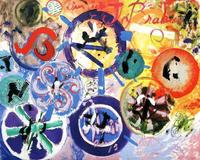
Family Tree
Ozdemir Atlan
Painting Number 5
Marsden Hartley
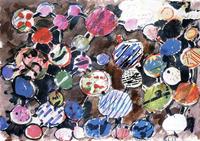
Family Tree
Ozdemir Atlan
The Joy of Life
Robert Delaunay
Colors and shapes
Alan Tellez
Untitled
Atsuko Tanaka
Snapper Bill
David Michael Hinnebusch
Untitled
Richard Pousette-Dart
Weizengelb
Ernst Wilhelm Nay
Abstract Pointillism
Gabino Amaya Cacho
Taxi Cab II
Al Held
Fanny Machine - The machinery
Frantisek Kupka
Untitled
Eileen Agar
Cannes
Natalia Dumitresco
Scheiben
Ernst Wilhelm Nay
Abstract Pointillism
Gabino Amaya Cacho
Untitled
Tsuruko Yamazaki