
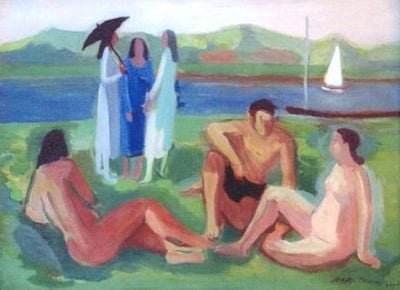
Expert analysis of Mario Zanini’s Figuras no Tietê
Style: Post-Impressionism · Genre: genre painting
Analysis of "Figuras no Tietê" by Mario Zanini
As a genre painting executed in a Post-Impressionist style, "Figuras no Tietê" captures a moment of everyday life along the Tietê River, a defining geographic and cultural artery of São Paulo. Zanini’s work is significant for its synthesis of European Post-Impressionist techniques with a distinctly Brazilian subject, reflecting the broader modernist movement in Brazil during the early-to-mid 20th century.
Post-Impressionist Characteristics
Post-Impressionism rejected the naturalism of Impressionism in favor of emotional expression, structural composition, and symbolic use of color. In this painting, Zanini likely employs:
- Expressive color and distortion to convey the sensory atmosphere of the riverbank—vivid blues, ochres, and greens may amplify the tropical light and heat, while simplified or elongated figures emphasize their human presence within the landscape.
- Robust brushwork that prioritizes texture and movement over optical accuracy, aligning with artists like Cézanne or Van Gogh, though Zanini adapts this to a local, urban-rural context.
- A deliberate composition that organizes the bustling genre scene—possibly workers, fishermen, or passersby—into a structured yet dynamic tableau, balancing spontaneity with formal harmony.
Significance within its Style and Period
The painting is emblematic of Brazilian Post-Impressionism, a phase that helped pave the way for the country’s modernist avant-garde (e.g., the Semana de Arte Moderna of 1922). Before Brazilian Modernism fully blossomed, artists like Zanini used Post-Impressionism to break away from academic art while grounding their imagery in national identity.
-
Capturing a Changing São Paulo: The Tietê River was a central site of daily life and labor in São Paulo—both pre-industrial and rapidly modernizing. By treating a genre scene (mundane activities) with Post-Impressionist vigor, Zanini elevates local realities to artistic significance, mirroring the period’s desire to represent Brazil’s own social and natural landscapes.
-
Contribution to Mário de Andrade’s Circle: Zanini was part of the Grupo Santa Helena, a collective of São Paulo artists who merged Post-Impressionist and Expressionist influences with working-class themes, distinct from the elite-focused academic tradition. “Figuras no Tietê” likely embodies their ethos: sincere, unglamorous portrayals of life, marked by robust painterly qualities and a sense of place.
Conclusion
“Figuras no Tietê” is significant as a bridge between European Post-Impressionist form and Brazilian content. It demonstrates how artists like Zanini used this style to document and dignify everyday experiences in São Paulo, contributing to the formation of a modern Brazilian visual language. The painting stands as a testament to the power of Post-Impressionism to not only transform how we see light and color, but also to assert the importance of local identity in global modernist currents.
Genre
Style
Visually similar
20 works with related composition and palette

Girls at the Edge of the Forrest
Roman Selsky
Playing Naked People
Ernst Ludwig Kirchner
The Bathers
Stanley Pinker
Zwei Akte Am See
Otto Mueller
Bathers After Cezanne II
Paul Wonner
Three Nudes
Ernst Ludwig Kirchner
Bathing boys
Pyotr Konchalovsky
Delectable Waters
Paul Gauguin
Orpheus and the Furies
Rosemarie Beck
Bathers
David Park
Four Bathers
Ernst Ludwig Kirchner
Nudes in the Sun
Ernst Ludwig Kirchner
Mother and child
Pyotr Konchalovsky
Untitled (Three Nudes)
Mark Rothko
Bathers
Pyotr Konchalovsky
Seated Nude
Henri Matisse
Three Nudes in the Forest
Otto Mueller
Landscape with Figures
Othon Friesz
Untitled (Nude with trellis and landscape)
Theophilus Brown
Junger Mann Und Mädchen
Erich Heckel