
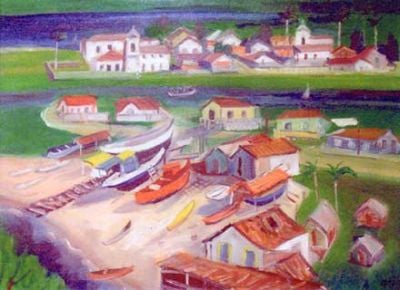
Analisi esperta di Parati di Mario Zanini
Stile: Post-Impressionism · Genere: cityscape
Analysis of "Parati" by Mario Zanini
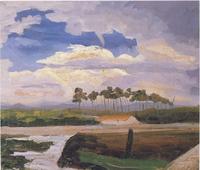
Mario Zanini’s "Parati" is a compelling example of Post-Impressionist cityscape painting, distinguished by its synthesis of European avant-garde techniques with a distinctly Brazilian subject. As a member of the Grupo Santa Helena, Zanini sought to capture the everyday life and landscapes of São Paulo state, and in "Parati" he turns his attention to the historic colonial town of Paraty, with its preserved Portuguese architecture and tropical surroundings.
Significance within Post-Impressionism
The work exemplifies Post-Impressionism’s departure from naturalistic representation toward emotional and structural expression. Zanini employs vivid, unblended colors and bold, rhythmic brushwork to convey the humid, luminous atmosphere of the coastal town. Rather than striving for photographic accuracy, he distorts perspective and flattens space, emphasizing the geometric blocks of whitewashed buildings against intense green hills and a deep blue sky. This manipulation of form and color reflects the influence of Cézanne’s structural approach and van Gogh’s expressive palette, but is grounded in Zanini’s own observation of Brazilian light and architecture.
Genre and Cultural Context
As a cityscape, "Parati" is significant for capturing a specific place and moment in Brazilian modernist history. In the 1940s and 1950s, Zanini and his contemporaries reframed local scenes—colonial towns, rural workers, urban peripheries—through a Post-Impressionist lens, moving away from academic naturalism. The painting’s bold contours and simplified shapes also hint at the influence of Fauvism and early Abstract tendencies, placing Zanini at the crossroads of European modernism and Brazilian identity.
Key Characteristics
- Color: Saturated blues, whites, and ochres create contrast and heat, suggesting the tropical climate.
- Brushwork: Energetic, visible strokes build texture and movement, animating the static architecture.
- Composition: Foreground streets lead the eye into the town, while the surrounding hills and sky create an enveloping, almost symphonic sense of place.
In summary, "Parati" is significant as a Post-Impressionist cityscape that transcends mere topographic record. It represents Zanini’s contribution to the modern reframing of Brazilian scenery, where European pictorial innovations are adapted to express the nation’s unique light, color, and spatial character. The painting stands as a testament to how Post-Impressionism, in the hands of a Brazilian master, became a vehicle for both personal expression and cultural affirmation.
Genere
Stile
Visivamente simili
20 opere con composizione e palette affini
Havana Harbor
Willard Metcalf
Marinha
Jose Pancetti
Paisagem De Sabara
Alberto da Veiga Guignard
Untitled
Nutzi Acontz
View of Acapulco
Carl Saltzmann
Balcic Gulf
Nutzi Acontz
Rua em São João del Rey
Jose Pancetti
Arraial do Cabo
Jose Pancetti
Sabará Chuvoso
Alberto da Veiga Guignard
Beira-mar
Mario Zanini
Cambuquira
Anita Malfatti
Untitled
Alfredo Volpi
Marinha com barcos
Mario Zanini
New Year's Day in the Harbour
Fujishima Takeji
Pé de jabuticaba
Anita Malfatti
Landscape
Paul Gauguin
Ancient Romanian Landscape II
Horia Bernea
Fantasia De Minas
Alberto da Veiga Guignard
Hiddensee
Walter Gramatté
Scenery in Southern France
Winston Churchill