Analisi esperta di Vozes di Manabu Mabe
Stile: Abstract Expressionism · Genere: abstract
Expert Analysis of "Vozes" by Manabu Mabe
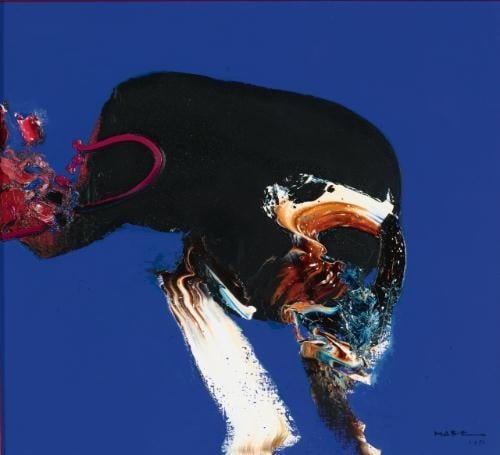
Manabu Mabe’s "Vozes" (Portuguese for “Voices”) stands as a compelling testament to the artist’s role in bridging Eastern gestural traditions with Western Abstract Expressionism. As a Japanese-Brazilian painter, Mabe infused the bold, spontaneous energy of Abstract Expressionism with the disciplined, lyrical calligraphy of sumi-e (ink painting), creating a distinctive visual language that resonates with both cultural roots and modernist innovation.
Significance within Abstract Expressionism:
While mid-century American Abstract Expressionists like Pollock and de Kooning emphasized raw, often aggressive gesture, Mabe’s work introduces a quieter, more meditative rhythm. In "Vozes," sweeping black strokes—reminiscent of Japanese brushwork—interweave with patches of vibrant color (earthy browns, deep blues, and accents of white). This interplay suggests multiple “voices” or layers of expression: the physical energy of the brush, the subtlety of negative space, and the emotional resonance of color. The painting exemplifies how Abstract Expressionism could be reinvented outside its New York epicenter, infusing it with global perspectives.
Cultural and Artistic Fusion:
Mabe’s significance lies in his synthesis. "Vozes" is not merely an abstract composition; it is a dialogue between two visual cultures. The calligraphic lines convey both the immediacy of Action Painting and the contemplative precision of East Asian ink art. The title itself—plural, inclusive—suggests a polyphonic approach where diverse influences speak simultaneously. This work helped define the Brazilian abstract movement of the 1950s–60s, offering an alternative to the geometric abstraction of Concrete Art while maintaining a uniquely lyrical sensibility.
Impact on Latin American Modernism:
As a pioneer of “abstraction lírica” (lyrical abstraction) in Brazil, Mabe demonstrated that Abstract Expressionism could transcend its American context. "Vozes" captures a moment when post-war artists sought new ways to express interior states and cultural identity without figuration. Its layered, energetic surface—built through rapid, deliberate gestures—invites viewers to “hear” the artist’s hand at work, making the act of painting itself a voice. This work remains significant for its affirmation that abstraction can be simultaneously personal, cultural, and universal.
Visivamente simili
20 opere con composizione e palette affini
Untitled
Manabu Mabe
Som
Manabu Mabe
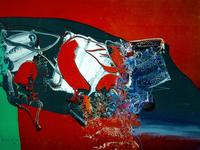
Age
Manabu Mabe
Untitled
Paul Jenkins
Untitled
Paul Jenkins
Judy
James Brooks
Matsuri no Hi
Kazuo Shiraga
Number 311
Roger Weik
Prince Patutsky Memoir: Turquoise and Yellow
Jules Olitski
Untitled
Paul Jenkins
Shisen
Kazuo Shiraga
Composition on the black
Istvan Molnar
Untitled
Paul Jenkins
Untitled
Shozo Shimamoto
"Under the Shear"
Roger Weik
Number 385
Roger Weik
Celebration
Kazuo Shiraga
Untitled
Oleksandr Aksinin
Number 384
Roger Weik
Phenomena Phoenix Equinox
Paul Jenkins