Analisi esperta di Golgotha di Lajos Gulacsy
Stile: Symbolism · Genere: religious painting
Expert Analysis of "Golgotha" by Lajos Gulacsy
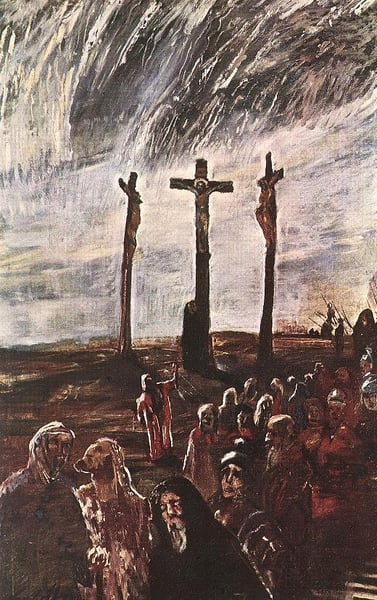
Lajos Gulacsy’s "Golgotha" is a striking example of Symbolist religious painting, where the biblical scene of the Crucifixion is transformed into a deeply subjective, atmospheric meditation on suffering and transcendence. Unlike traditional religious iconography, which often emphasizes narrative clarity or devotional realism, Gulacsy employs the Symbolist idiom to prioritize mood, inner emotion, and mystical suggestion.
Significance within Symbolism:
As a Hungarian Symbolist, Gulacsy was part of a broader European movement that rejected naturalism in favor of evocative, dreamlike imagery. In "Golgotha," this manifests through a likely muted, ethereal palette, elongated or ghostly figures, and an otherworldly setting—all of which distance the scene from literal history and draw it into a realm of personal, symbolic resonance. The work aligns with Symbolism’s fascination with spirituality, melancholy, and the boundaries between the physical and the metaphysical.
Significance as a Religious Painting:
Gulacsy’s treatment of Golgotha subverts conventional Passion imagery. Instead of focusing on Christ’s physical agony or the redemptive act, the painting likely emphasizes isolation, transience, and the dreamlike weight of sacrifice. This reflects a fin-de-siècle sensibility where religious motifs were re‑examined through a lens of psychological depth and existential questioning. The work stands out for its ability to evoke the sacred through suggestion rather than explicit narration, making it a unique contribution to both Symbolist art and the long tradition of Crucifixion depictions.
In essence, "Golgotha" is significant for how it merges a timeless religious subject with Symbolism’s core ambition: to render the invisible—emotion, memory, and the sublime—visible through art.
Visivamente simili
20 opere con composizione e palette affini
Calvary
Odilon Redon
Crucifixion
Nikolai Ge
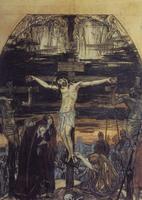
Crucifixion
Viktor Vasnetsov
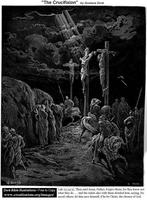
The Crucifixion
Gustave Dore
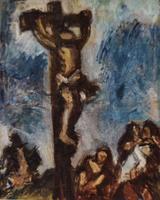
Golgota
Bela Czobel
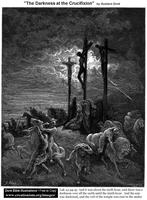
The Darkness At The Crucifixion
Gustave Dore
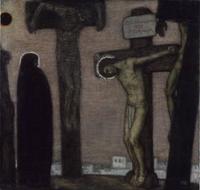
Golgotha
Franz Stuck
Cursed field. The place of execution in ancient Rome. Crucified slave
Fyodor Bronnikov
Crucifixion, Sketch #3
Robert Spencer
Crucifixion
Franz Stuck
Redemption
Czesław Jan Pyrgies
Calvary
Octavio Ocampo
The Three Crosses
Peter Paul Rubens
The Three Crosses
Rembrandt
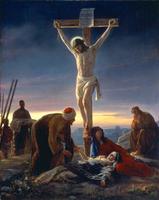
The Crucifixion
Carl Bloch
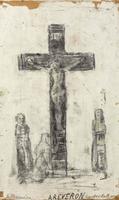
Crucifixion
Armando Reveron
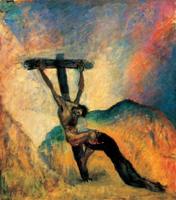
Bereny Robert, Krisztus a Kereszten. 1912
Berény Róbert
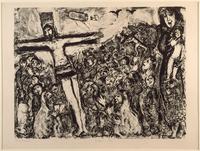
Crucifixion
Marc Chagall
Rizpah's Kindness toward the Dead
Gustave Dore
Untitled
Zdzislaw Beksinski