
Analisi esperta di Door, Mirror, Table, Basket, Rug, Window di Richard Artschwager
Stile: Conceptual Art · Genere: interior
Expert Analysis: "Door, Mirror, Table, Basket, Rug, Window" by Richard Artschwager
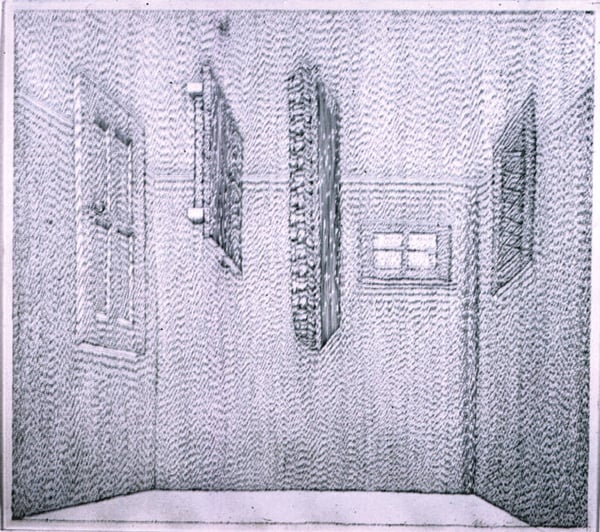
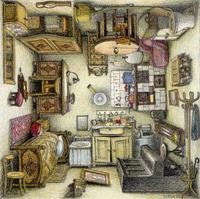
As a seminal work within the conceptual art movement of the 1960s and 1970s, Richard Artschwager’s Door, Mirror, Table, Basket, Rug, Window challenges the very boundaries between art object, furniture, and lived environment. The title itself functions as a literal inventory of depicted or constructed elements, foregrounding the conceptual strategy of naming over visual illusion. By listing everyday, domestic items, Artschwager forces the viewer to confront the gap between language and perception—a hallmark of conceptual art—while simultaneously blurring the lines between sculpture, painting, and functional design.
Stylistically, the work belongs to Artschwager’s characteristic use of industrial materials (often Formica and Celotex) to render banal household objects in a flattened, schematic manner. Here, the “interior” genre is not a window into a realistic space but a self-reflexive commentary on how we frame and categorize reality. The piece oscillates between being a painted representation of a room and a literal collection of quasi-functional objects, undermining traditional distinctions between high art and everyday life. Its significance lies in its radical redefinition of the artwork as an idea or system of relations rather than a purely aesthetic object—inviting the viewer to question not only what is seen but how something comes to be considered art at all.
Genere
Stile
Visivamente simili
20 opere con composizione e palette affini
Exlibris of E.Buryakovska
Oleksandr Aksinin
Henry Inn No. 5
Charles Garabedian
All alone in the Museum of Art
Howard Hodgkin
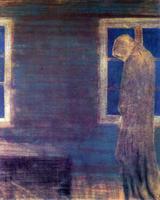
Funeral Symphony (VII)
Mikalojus Konstantinas Ciurlionis
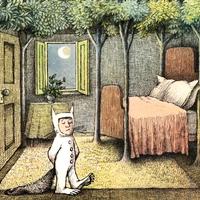
Where The Wild Things Are
Maurice Sendak
Studies of the Interior of a Cottage, and a Sketch of The Potato Eaters
Vincent van Gogh
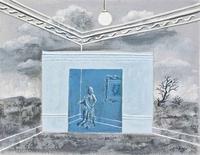
Projet pour le miroir magique
Jean Hugo
STUE
Tal R
Resurrection
Oleksandr Aksinin
Reunion and Departure
Enrico Pinardi
Mondrian Room
Gregorio Undurraga
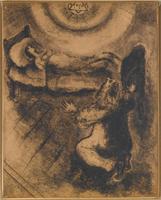
Elijah resurrects the son of the widow of Zarephath (I Kings, XVII, 17-22)
Marc Chagall
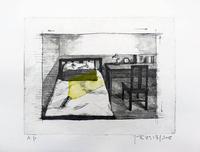
Green Wall series No. 2
Zhang Xiaogang
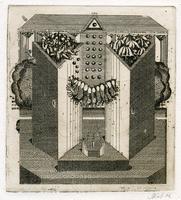
Exlibris of I.Soboleva
Oleksandr Aksinin
Niebioskości 2
Lech Jankowski
Interior
Kuzma Petrov-Vodkin
Night Tears. From the Album 'Florence'
Viktor Pivovarov
French Window at Collioure
Henri Matisse
Monochrome red (theater)
Yves Klein
Habitat
Jacek Yerka