Analisi esperta di Ecriture No.40~84 di Park Seo-Bo
Stile: Minimalism · Genere: abstract
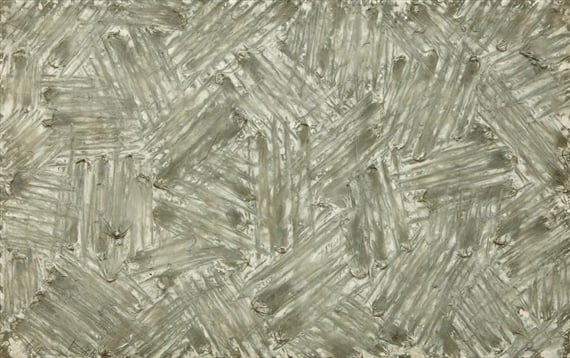
Expert Analysis: "Ecriture No.40~84" by Park Seo-Bo
Park Seo-Bo’s Ecriture No.40~84 is a seminal work within the Korean Dansaekhwa (monochrome painting) movement, which shares a conceptual kinship with Western Minimalism but diverges through its emphasis on process, materiality, and meditative repetition. This piece belongs to the artist’s long-running Ecriture series (from the French for “writing”), a body of work that redefines painting as a performative, almost calligraphic act.
Significance within Minimalism and Abstraction
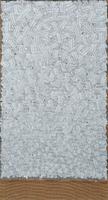
While Minimalism in the West often prioritizes industrial surfaces, hard edges, and the reduction of expressive gesture, Park’s approach is distinctly organic and tactile. Ecriture No.40~84 features a muted, nearly monochromatic ground—typically white or off-white—over which the artist has meticulously drawn thousands of pencil lines in a rhythmic, grid-like pattern. The repetition is not mechanical; each line retains the subtle pressure and rhythm of the artist’s hand, creating a pulsating, almost vibrating surface that invites close viewing. This aligns with Minimalism’s desire to strip away narrative and illusion, yet it adds a layer of Eastern philosophical resonance: the act of line-making becomes a kind of disciplined meditation, echoing the practice of seon (Zen) calligraphy or the repetitive strokes of ink painting.
Process as Content
The title, with its numerical sequence, underscores the serial nature of the work—each piece in the series is a variation on a single procedure. Park employed a technique of drawing wet paint with a pencil while the pigment was still damp, allowing the tool to drag and scar the surface. This yields a textured, almost wounded field that records time and labor. Ecriture No.40~84 is significant because it bridges the gap between Abstract Expressionist action painting and Minimalist objecthood: the work is both an index of the artist’s bodily presence and a rigorously systematic composition that denies emotional outburst.
Cultural and Art-Historical Context
Created during the 1970s–1980s, when Park was a leading figure of Dansaekhwa, this piece reflects a post-Korean War search for identity through restraint and material honesty. Unlike many Western Minimalists who rejected spirituality, Park’s practice is deeply informed by Taoist and Buddhist notions of emptiness (the white ground) and the endless cycle of birth and decay (the repetitive lines). Ecriture No.40~84 thus stands as a key example of how Minimalism was reimagined in a non-Western context—not as a negation, but as a path to transcendence through concentrated, humble repetition. Its significance lies in this fusion: a global conversation between the minimal and the meditative, the abstract and the profoundly human.
Genere
Stile
Visivamente simili
20 opere con composizione e palette affini
Cicada (ULAE 219)
Jasper Johns
Untitled (ULAE S13)
Jasper Johns
Conjunction No. 97-035
Ha Chong-Hyun
Between the Clock and the Bed
Jasper Johns
Corpse and Mirror
Jasper Johns
Scent
Jasper Johns
Cicada
Jasper Johns
Untitled
José Pedro Costigliolo
Usuyuki (ULAE 227)
Jasper Johns
Usuyuki (ULAE 211)
Jasper Johns
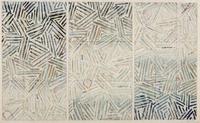
Between the Clock and the Bed
Jasper Johns
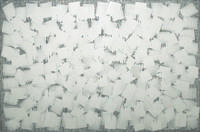
Conjunction 04-13
Ha Chong-Hyun
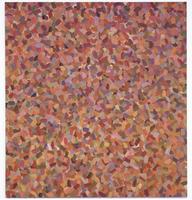
Broken Color: Cadmium Red, Cadmium Yellow, Ultramarine Blue
Marcia Hafif
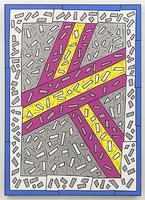
Grand Entrance
Nicholas Krushenick
Composition
Alexandre Istrati
Grün-Rot
Otto Freundlich
Untitled
Jasper Johns
Untitled
Décio Vieira
Brushstrokes
Sol LeWitt
Dancers on a Plane
Jasper Johns