
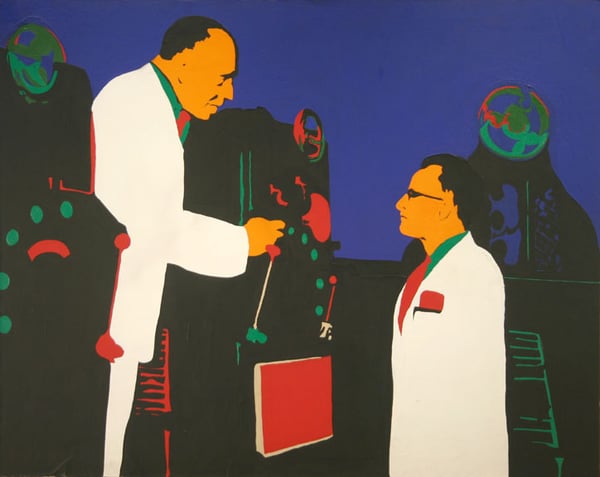
Expertenanalyse zu Rosalyn Drexlers Men and Machines V
Stil: Pop Art · Genre: figurative
Expert Analysis: "Men and Machines V" by Rosalyn Drexler
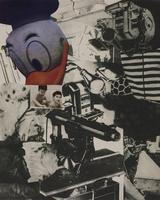
Rosalyn Drexler’s Men and Machines V stands as a compelling contribution to Pop Art, a movement that revolutionized the art world by embracing the imagery of mass media, advertising, and consumer culture. Yet Drexler—one of the few prominent women within the predominantly male Pop sphere—brought a distinct critical edge to the genre. This work belongs to her important series of the same name, which systematically explores the intersection of human identity and industrial technology.
Significance within Pop Art and Drexler’s Oeuvre
- Gendered Critique of Modernity: While many male Pop artists (Warhol, Lichtenstein) focused on celebrity, comic strips, or commodity objects, Drexler turned her lens on masculine identity in an age of mechanization. Men and Machines V explicitly juxtaposes the human male form with machinery, probing the tension between individuality and dehumanization. This thematic focus distinguishes her as a feminist voice within Pop, questioning the very notion of “manhood” as it becomes entangled with industrial power.
- Collage-Like Composition: Drexler often employed a flattened, cutout aesthetic reminiscent of collage or assemblage—a technique she honed through her earlier work as a playwright and sculptor. The “V” in the title suggests a serial approach typical of Pop repetition, yet Drexler’s handling is less about mechanical replication (à la Warhol) and more about isolating a charged, often awkward confrontation between flesh and steel. This visual tension underscores Pop Art’s interest in how mass production alters perception of the human body.
- Figurative Precision with Conceptual Depth: The figurative genre here is deceptive: the figures are not merely representational but symbolic. Drexler’s men and machines are rendered with bold outlines and flat color fields, echoing comic strips and billboards, but the pairing invites reflection on labor, control, and the erosion of individual agency. She critiques the very systems that Pop Art often seemed to celebrate—consumption, industry, and entertainment.
Why “Men and Machines V” Matters
Within the broader Pop canon, Drexler’s series offers a counter-narrative to the era’s fascination with technological progress. By placing “Men” before “Machines,” she foregrounds human vulnerability, suggesting that the mechanization of society is not a neutral evolution but a transformation fraught with psychological and social consequence. Her work presages later feminist and postmodern critiques, cementing her as a vital—and still underrecognized—figure in American art.
In short, Men and Machines V exemplifies how Pop Art could function as both a mirror and a scalpel: reflecting modern life while dissecting its assumptions. Drexler’s incisive vision makes this piece a significant document of the movement’s deeper critical potential.
Genre
Stil
Visuell ähnlich
20 Werke mit ähnlicher Komposition und Farbpalette
No. 2, Main Control Panel, Nerve Center of Ship
Jacob Lawrence
Working controls while submerged
Eric Ravilious
Study for Men and Machines I
Rosalyn Drexler
Love Parade
Francis Picabia

Sketch of the Mosaic Panel 'Scheme of World Structure' for the Exterior Design of the Ternopil Cotton Mill
Valerii Lamakh
Cover of the Radio Times Christmas Number for 1930
Paul Nash

Telecommunications
Paul Nash
Professor Dowell's Head (part I)
Oleg Holosiy
Men operating submarine controls
Eric Ravilious
The US Army Trades
Norman Rockwell
Knife Sharpener
Jack Bush
Mad scientist
Roy Lichtenstein
Arts of the City
Thomas Hart Benton
Love Parade
Francis Picabia
Pop Shop III
Keith Haring

Dr. George Washington Carver
William H. Johnson
Working Submarine Controls Submerged
Eric Ravilious
Glassless stereoscopic movie system
David Kakabadze
Tool Box 6
Jim Dine
Restaurant (The Waitress)
Charles Garabedian