
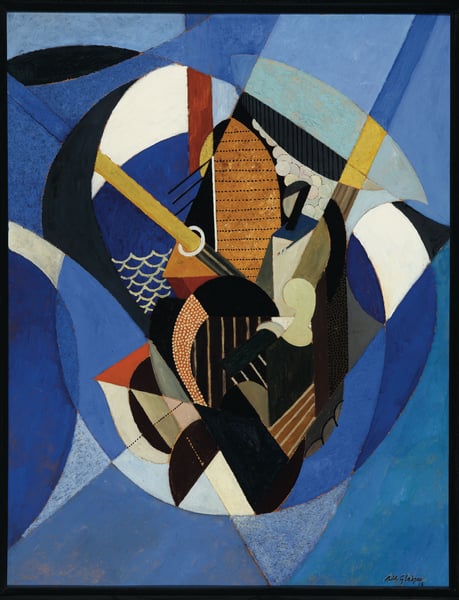
On a Sailboat
Expert analysis of Albert Gleizes’s On a Sailboat
Style: Cubism · Genre: marina
Expert Analysis: "On a Sailboat" by Albert Gleizes
Albert Gleizes’ “On a Sailboat” stands as a compelling example of how Cubist principles transform a traditional genre—the marina—into a dynamic, multi-perspectival composition. As a foundational figure in the development of Cubism (alongside artists like Jean Metzinger), Gleizes here applies the movement’s core innovations to a subject long associated with representational, atmospheric painting: boats, water, and sky.
Cubist Deconstruction of the Marine Subject
In typical Cubist fashion, Gleizes breaks down the recognizable elements of a sailboat and its surroundings into overlapping geometric planes. The hull, sails, and waves are no longer rendered as continuous, illusionistic forms; instead, they are fragmented into facets that simultaneously present multiple viewpoints. The viewer sees the boat from above, from the side, and from within the same canvas—a rejection of single-point perspective that challenges the passive observation of a seascape.
Rhythm and Structure
The composition’s significance lies in its refusal to let the subject dissolve into complete abstraction. Gleizes maintains a clear thematic anchor—the sailboat on water—while reorganizing the space through dynamic diagonal lines and interlocking shapes. The “sail” becomes a series of tilted, angular planes; the “water” is suggested by sliding, stepped surfaces rather than fluid curves. This tension between recognizable content and formal invention is a hallmark of Gleizes’ mature Cubist works.
Contribution to the Genre
“On a Sailboat” demonstrates that Cubism could revitalize even the most scenic, picturesque genres. Unlike the heroic or still-life subjects favored by Picasso and Braque, Gleizes takes a leisure-time maritime scene and elevates it into a study of spatial relationships and perceptual multiplicity. In doing so, he expands the reach of Cubist vocabulary—proving that any aspect of modern life, from a Sunday sail to a harbor view, could be reimagined through the movement’s analytical lens.
Legacy
This work is significant because it exemplifies Gleizes’ theoretical commitment to “mobile perspective” and the synthesis of time and space on a flat canvas. It challenges the viewer to engage actively, piecing together the boat’s essence from scattered visual clues. As a Cubist marina, it stands as a bold redefinition of what a seascape can be: not a window onto nature, but a constructed, intellectual experience of motion, light, and form.
Visually similar
20 works with related composition and palette

Naturaleza Muerta Mujer Con Mandolina
Maria Blanchard

Orquesta Sinfonica
Man Ray

Composicion IV
Oswaldo Vigas

Woman with Guitar
Maria Blanchard
Ballerina on an Ocean Liner
Francis Picabia

Abstract Composition No. 6
Marthe Donas

Propellers 2nd state
Fernand Leger

Guitar on pedestal
Pablo Picasso

Untitled
Lee Krasner

Black Pierrot
Jindrich Styrsky

Composition
Georges Valmier

Tolérance
Georges Troubat

Komposition
Gosta Adrian-Nilsson
Naturaleza Muerta
Maria Blanchard

Figures and Marine Anchor
Louis Marcoussis

Composición
Maria Blanchard

Untitled
Ad Reinhardt

Naturaleza Muerta Composición
Maria Blanchard

Composición Cubista
Maria Blanchard
The Cyclist
Gino Severini