Serrieres
Expert analysis of Albert Gleizes’s Serrieres
Style: Cubism · Genre: landscape
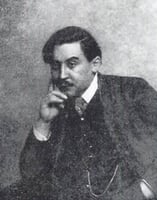
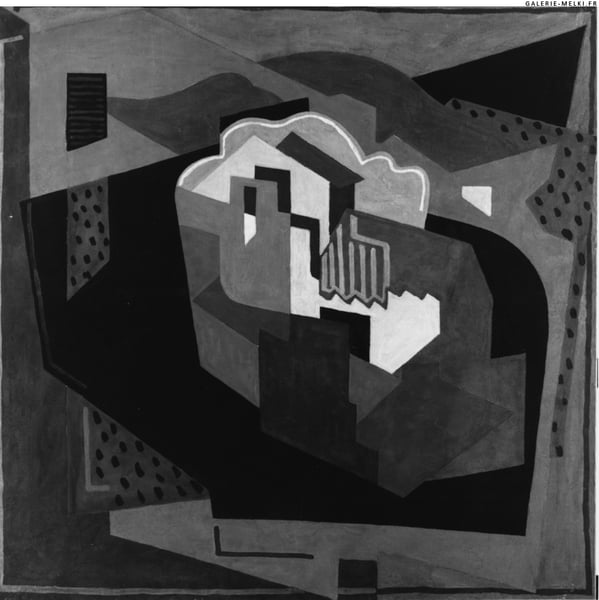
Albert Gleizes’ Serrieres (c. 1912–13) stands as a quintessential example of Analytical Cubism applied to the landscape genre—a bold departure from the still lifes and portraits more commonly associated with Picasso and Braque. As a leading theorist of the movement and a key member of the Section d’Or, Glezes pushed Cubist principles into new thematic territory, and Serrieres demonstrates how a rural scene could be systematically deconstructed into a dynamic grid of interlocking facets.
Significance within Cubism and Landscape Painting
While early Cubist landscapes by Braque (e.g., L’Estaque series) had already broken with traditional perspective, Gleizes’ treatment of Serrieres is notable for its aggressive synthesis of space and form. The painting does not merely fragment a single viewpoint; it presents multiple simultaneous perspectives on the trees, buildings, and terrain, reassembling them into a coherent, almost architectural whole. The composition is dense and rhythmic, with faceted planes radiating outward from a central axis—perhaps the vertical thrust of a tree or the tilt of a roof—creating a sense of dynamic equilibrium.
Gleizes was deeply interested in the mathematical and spiritual underpinnings of Cubism, and in Serrieres this manifests in a careful balance between geometric abstraction and recognizable subject matter. The palette is subdued—typically ochres, browns, and grays, with sharp accents of blue or green—reinforcing the intellectual rigor of the process. The landscape is not “seen” but “known,” reconstructed through the artist’s analytical eye.
What Makes This Work Exceptional
-
Expansion of Cubist Vocabulary: At a time when Cubism was often criticized as being cold or overly intellectual, Glezes’ landscape retains a lyrical, almost musical quality. Serrieres shows that deconstruction could convey the essence of a place—its atmosphere, structure, and rhythm—rather than merely stripping it down.
-
Theoretical Anchoring: Glezes later codified his ideas in Du Cubisme (1912), co-authored with Jean Metzinger, which argued for the “integration of objects in a new pictorial space.” Serrieres effectively visualizes that theory: the picture plane becomes a field where solid and void, near and far, interpenetrate without hierarchical priority.
-
Landscape as Structural Logic: Unlike Impressionist landscapes that captured fleeting light, or Cézanne’s that hinted at underlying geometry, Glezes’ landscape declares its own construction. The viewer is compelled to read the painting as a set of relational volumes—trees become cylinders, hills become inclined planes, and sky becomes a set of tilted facets that continue the earthly structure upward.
In summary, Serrieres is significant because it demonstrates how Cubism—often seen as a movement of the studio and the café—could engage with the natural world on its own radical terms. It is a landscape that thinks, decomposing and recomposing the act of seeing into a pure spatial language.
Visually similar
20 works with related composition and palette
Costruzione spaziale - paesaggio
Enrico Prampolini
Bureau and Room
Kazimir Malevich
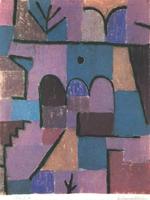
Oriental Garden
Paul Klee
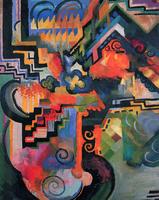
Colored Composition (Homage to Johann Sebastian Bach)
August Macke
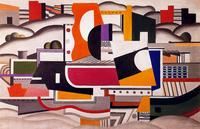
The great tug
Fernand Leger
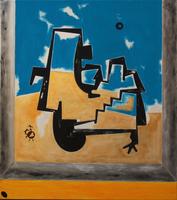
Hiram Abif's portrait
Carloluigi Colombo
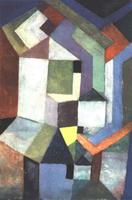
Pious northern landscape
Paul Klee
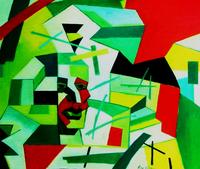
Lost Without A Trace
Nina Tokhtaman Valetova
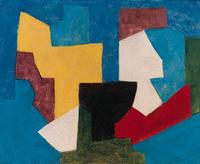
Composition multicolore à dominante bleue
Serge Poliakoff
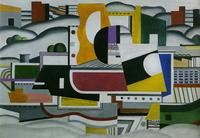
The Large Tug boat
Fernand Leger
Seated Lovers
Carloluigi Colombo
Composition grise, rouge et jaune
Serge Poliakoff
Composition, Landscape at Ceret
Auguste Herbin
Cubist Composition
Maria Blanchard
Architectural Form of Future Ideal Landscape
Enrico Prampolini
Composizione futurista
Julius Evola
Composition
Georges Valmier
The Stove
Fernand Leger
Heavy Forms/Pink
Robert Blackburn
Stage Landscape
Paul Klee