Untitled
Analisi esperta di Untitled di Albert Gleizes
Stile: Abstract Art, Cubism · Genere: abstract
Analysis of "Untitled" by Albert Gleizes
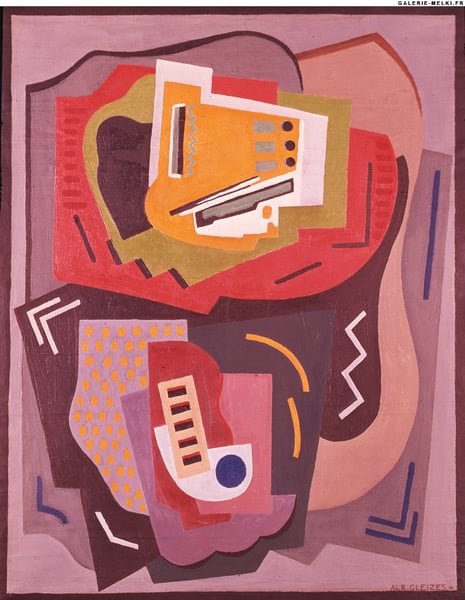
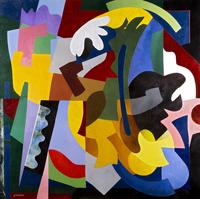
Albert Gleizes’s Untitled stands as a compelling testament to the radical formal innovations of early Cubism and its transition toward pure abstraction. As one of the founding theorists and practitioners of Cubism—co-authoring the seminal 1912 treatise Du “Cubisme” with Jean Metzinger—Gleizes sought to move beyond mere representation into a language of geometry, dynamic structure, and multiple viewpoints.
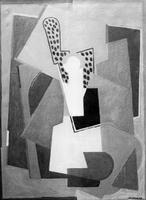
In this abstract work, Gleizes dismantles the traditional single-point perspective, instead fracturing the picture plane into a series of interlocking planes, angular facets, and rhythmic lines. The composition is both structured and fluid: forms appear to tilt, slide, and intersect, creating a sense of movement that invites the viewer to mentally reconstruct the subject from shifting angles. This method embodies the Cubist belief that art should capture not just one moment in time but the total experience of an object—its front, side, and interior simultaneously.
Significantly, Untitled reflects Gleizes’s shift away from recognizable subject matter toward a more autonomous, non-representational system. While early Cubist works often retained identifiable motifs (still lifes, figures), Gleizes’s mature abstract pieces—especially in the 1910s and 1920s—emphasized pure form, color modulation, and spatial tension. The absence of a title reinforces this move: the work is meant to be understood on its own formal terms, as a composition of relationships rather than a depiction of something.
Stylistically, the painting aligns with the analytical and synthetic phases of Cubism but also anticipates the more abstract, spiritual geometry that Gleizes would explore later with the Section d’Or group. The careful balance of warm earth tones and cooler, subdued hues avoids sensory overload, instead directing focus to the interplay of positive and negative space. The layered, translucent planes create a shallow depth that feels both architectural and musical—edges echo and rhyme, building a rhythm that seems to extend beyond the canvas.
In the trajectory of modern art, Gleizes’s Untitled is significant because it demonstrates how Cubism, often misunderstood as merely a style of fragmentation, was in fact a profound philosophical inquiry into perception and reality. Gleizes insisted that art should reflect cosmic order and universal harmony, and this work—though abstract—conveys a strong sense of balance and intentional structure. It challenges the viewer to see not just with the eye but with the mind, making it a key example of Cubism’s radical redefinition of visual language and its essential role in paving the way for later non-objective art.
Visivamente simili
20 opere con composizione e palette affini
Early Geometric
Burgoyne Diller
Landscape
Georges Valmier
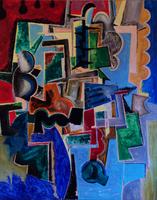
Harbor of Ravenna
Carloluigi Colombo
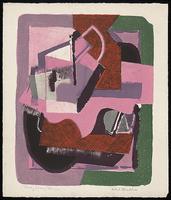
Heavy Forms/Pink
Robert Blackburn
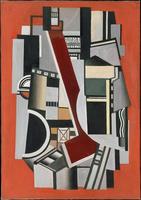
Mechanical Elements on red background
Fernand Leger
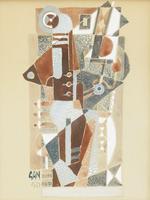
Komposition
Gosta Adrian-Nilsson
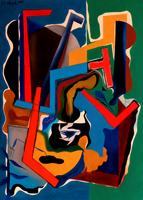
Still Life with Self Portrait
Carloluigi Colombo
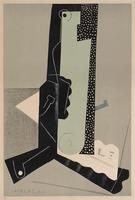
Composition
Henri Laurens
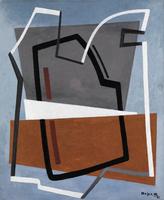
Repercussion 4
Alberto Magnelli
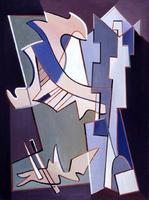
With Premeditation
Alberto Magnelli
Flamelet Picture
Willi Baumeister
Paesaggio interiore, apertura del diaframma
Julius Evola
XXV
Anne Ryan
Abstract Composition No. 6
Marthe Donas
Red spot II
Wassily Kandinsky
Italian Landscape in 2073 BC
Carloluigi Colombo
Composition
Albert Gleizes
Mystere vert
Alberto Magnelli
Un Bel Été 100 X 100 Cm 2020 G TROUBAT
Georges Troubat
Untitled
Ad Reinhardt