
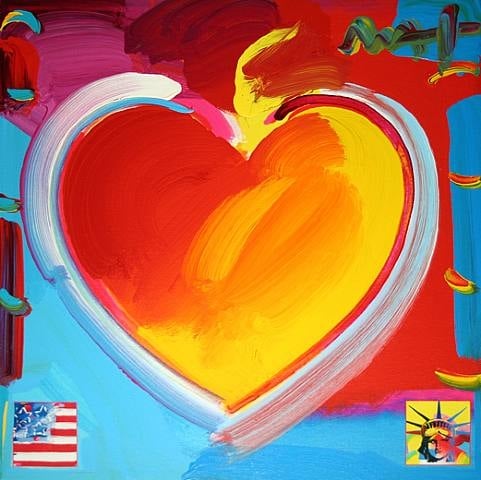
Analisi esperta di Heart di Peter Max
Stile: Pop Art · Genere: figurative
Artwork Analysis: Heart by Peter Max (c. 1960s–1970s)
Style & Context:
Peter Max emerged as a leading figure in the 1960s Pop Art movement, but his work diverged from the commercial critique of Warhol or the deadpan irony of Lichtenstein. Instead, Max infused Pop Art with a distinctly optimistic, psychedelic energy—vibrant, chromatic, and emotionally direct. Heart exemplifies this hybrid: while its subject (a universal symbol) and flat, graphic execution align with Pop’s embrace of mass-media imagery, its kaleidoscopic color palette and fluid contours reflect Max’s fascination with mystical and cosmic themes. The work bridges Pop Art’s fascination with popular culture and the counterculture’s search for transcendent expression.
Significance:
Heart is significant for several reasons:
- Icon of Psychedelic Pop: Max’s use of blazing primaries (red, yellow, blue) and concentric, radiating forms turns a clichéd symbol into a pulsating, almost hypnotic emblem. This approach helped define the visual language of the late 1960s, merging high art with the graphic aesthetics of rock posters, album covers, and the “Age of Aquarius.”
- Democratization of Symbol: Unlike Warhol’s detached soup cans, Max’s Heart invites emotional engagement. By placing a universally recognized shape at the center of a Pop vocabulary, he reclaims sentimentality and joy as legitimate subjects for avant-garde art—a radical gesture in an era often dominated by irony or critique.
- Evolution of Figurative Pop: While Pop Art frequently used figures (Lichtenstein’s comic women, Wesselmann’s nudes), Max’s figure is reduced to pure symbol. This distillation pushes Pop toward abstraction while retaining immediate readability, foreshadowing later trends in neo-pop and street art.
Technical & Compositional Notes:
- Bold Outline: A thick, unmodulated black contour encloses the heart, mimicking comic-book linework and anchoring the explosion of color.
- Layered Chromatics: Crayon-like strokes or airbrushed gradients create a sense of vibration, as if the heart is glowing or in motion—a hallmark of Max’s “cosmic” period.
- Negative Space: The background is often a flat, primary yellow or white, forcing the heart to float as a pure icon, stripped of context.
Conclusion:
Heart is not merely a decorative Pop work; it is a key artifact of Pop’s expansion into spiritual and psychedelic territory. It demonstrates how Pop Art could be both accessible and deeply personal, reflecting the era’s yearning for unity and positivity. Max’s Heart remains a lasting symbol of art’s ability to find profundity in the simplest shapes.
Visivamente simili
20 opere con composizione e palette affini
Confetti Heart
Jim Dine
Two Hearts in a Forest
Jim Dine
Audincourt window
Fernand Leger
It is True
Terry Frost

Love is Forever
Richard Spare
Welcome Home Rare Birds
Jim Dine
Four Hearts
Jim Dine
Inima IX
Ion Nicodim
ONE
Charles James
Cow is Beef
Burhan Dogancay

The Funeral
Rut Bryk

III Notes from Salalah, (Note II)
Cy Twombly
Bleeding Heart
Bernadette Resha
Untitled
Linde Martin
Dingkarri
Sally Gabori
King Alfred's Country - Makakirr
Sally Gabori
Dibirdibi Country
Sally Gabori

Dibirdibi Country
Sally Gabori
Empress
Albert Irvin
Dibirdibi
Sally Gabori