Expert analysis of Peter Max’s JFK
Style: Pop Art · Genre: portrait
Expert Analysis: "JFK" by Peter Max
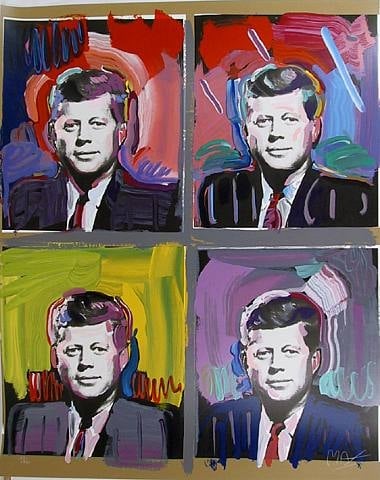
Peter Max’s portrait of John F. Kennedy stands as a quintessential example of how Pop Art absorbed and transformed America’s political iconography in the 1960s. While many Pop artists—Warhol, Lichtenstein—drew from consumer advertising and comic strips, Max merged this sensibility with a psychedelic palette and a loose, expressive linework that became his signature. His “JFK” is not merely a likeness; it is a visual meditation on the intersection of celebrity, heroism, and national trauma.
Stylistic Significance: Psychedelic Pop Synthesis Max’s work bridges the clean, graphic boldness of early Pop Art with the counterculture’s embrace of vibrant, hallucinatory color. In “JFK,” the president’s face is rendered with simplified, almost cartoonish contours—a hallmark of Pop’s flattening of depth—yet the unexpected color shifts (perhaps electric blues, hot pinks, or lime greens) inject a sense of energy and emotional immediacy. This psychedelic inflection distinguishes Max from his contemporaries: where Warhol’s JFK silkscreens are cool, repetitive, and deadpan, Max’s portrait pulses with life, suggesting both the dynamism of Kennedy’s “New Frontier” and the dizzying, fragmented experience of 1960s media culture.
Genre and Subject: The Iconic Portrait as Cultural Mirror As a portrait of an American president, “JFK” belongs to a long tradition of political imagery, but Max reinterprets it through the lens of Pop’s democratic appropriation of mass-media images. Kennedy was perhaps the first president whose image was carefully manufactured for television; Max amplifies this by treating the face as a reproducible icon, much like a campaign poster or magazine cover. The significance lies in the tension between reverence and critique: the vibrant colors and simplified forms elevate JFK to the status of a modern saint, while the detached, almost commercial rendering reminds us that political charisma is itself a product of media spectacle.
Historical Context: A Nation in Mourning, a Style Reborn Created in the aftermath of JFK’s assassination, Max’s portrait also participates in the collective act of memorialization. Pop Art’s habit of repeating and reproducing images takes on a poignant weight here—JFK’s face, endlessly circulated in news photographs, becomes a shared symbol of lost promise. Max’s version, with its saturated hues and fluid outlines, offers a more optimistic, even transcendental, counterpoint to the stark black-and-white images of grief. It captures the contradictory American mood of the 1960s: the idealism of the space race and civil rights movement shadowed by violence and disillusionment.
What Makes It Significant “JFK” is significant not only as a deft fusion of Pop and psychedelic aesthetics but also as a case study in how art can mediate public memory. Max transforms a political portrait into a pop artifact—accessible, colorful, and emotionally resonant—while preserving the gravity of its subject. The work reminds us that Pop Art was never just about soup cans; it was also a means of processing the most powerful images of our time, from the mundane to the heroic. In Peter Max’s hands, JFK becomes both a man and a myth, captured in a palette that refuses to fade.
Visually similar
20 works with related composition and palette
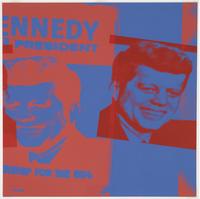
Flash--November 22, 1963
Andy Warhol
Portrait of a Man
Mehram Sheikholeslami
Armin Wolf
Gazmend Freitag
Flash--November 22, 1963
Andy Warhol
John Kennedy
Omer Mujadžić
Agron Krasniqi
Gazmend Freitag
Franz Dobusch
Gazmend Freitag
Bedri Tahiri
Gazmend Freitag
Krist Maloki
Gazmend Freitag
Portrait of John F.Kennedy
Norman Rockwell
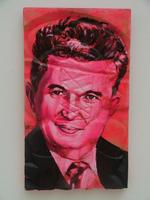
Ceausescu
Dumitru Gorzo
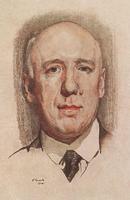
Portrait of F. Sologub
Konstantin Somov
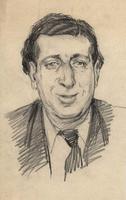
Arno Babajanian
Babken Kolozyan
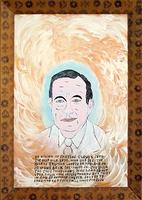
President Harry Truman
Howard Finster
Dr. Yakov Bach
Alexander Bogen
Hazir Mehmeti
Gazmend Freitag
ein guter roter vers. 2.0
Malte Sonnenfeld
Jimmy Carter
Andy Warhol
Ads: Van Heusen (Ronald Reagan)
Andy Warhol
Portrait of Jack Greenbaum
Elaine de Kooning