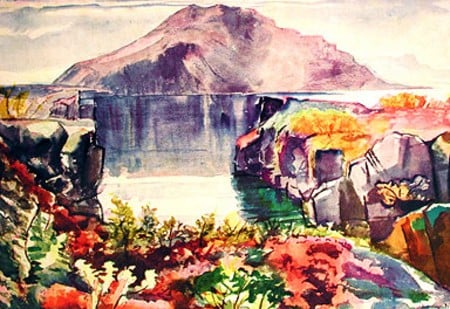
Asgrimur Jonsson sanatçısının Lava Gorge at Thingvellir, Autumn eseri hakkında uzman analizi
Tarz: Impressionism · Tür: landscape
Expert Analysis of "Lava Gorge at Thingvellir, Autumn" by Ásgrímur Jónsson
Ásgrímur Jónsson (1876–1958) is celebrated as the first Icelandic painter to fully embrace Impressionism, adapting the movement’s core principles—broken brushwork, natural light, and atmospheric color—to the distinctive landscapes of his homeland. Lava Gorge at Thingvellir, Autumn exemplifies this synthesis, marking a significant moment in the history of Icelandic art.
Significance within Impressionism and Icelandic Landscape Painting:
-
Translation of Impressionist Technique to a Northern Sublime
Unlike the soft, pastoral scenes of French Impressionists (Monet, Pissarro), Jónsson applies similar methods—short, visible strokes and a focus on shifting light—to Iceland’s dramatic geology. The “lava gorge” at Thingvellir, a rift valley created by tectonic activity, is rendered not as a static, monumental vista but as a living environment where autumn hues (amber, ochre, deep green) interact with the low, raking Nordic sun. The paint handling suggests the fleeting quality of a crisp fall afternoon, with light passing over basalt formations and reflecting in pools. -
Cultural and Naturalist Identity
Thingvellir holds immense historical and symbolic importance as the site of Iceland’s ancient parliament (Alþingi) and a UNESCO World Heritage location. By choosing this subject, Jónsson elevates a national landmark from mere topography into a record of atmospheric experience. The “autumn” season further emphasizes transience—a key Impressionist preoccupation—while grounding the work in Iceland’s specific climate cycle. This bridges the European movement with a local, even patriotic, sense of place. -
Coloration and Mood
Jónsson’s palette in this work is particularly noteworthy: he uses earthy, volcanic tones (deep browns, soft grays, mossy greens) punctuated by bursts of autumnal yellow and orange. This is not the bright, sun-drenched palette of Mediterranean Impressionism but a more muted, northern range that captures the subdued luminosity of an Icelandic autumn. The result is both emotionally resonant and scientifically observant, demonstrating how Impressionism could be reshaped for a non-French environment. -
Legacy as a Pioneer
As the first Icelander to study at the Royal Danish Academy of Fine Arts and later in Paris, Jónsson returned home to apply Impressionist theories to Icelandic motifs. Lava Gorge at Thingvellir, Autumn stands as a mature example of his ability to make a foreign style feel native—transforming rugged lava fields into subjects of delicate, transient beauty. This work thus represents a pivotal moment when Icelandic visual identity entered the mainstream of modern European painting.
Conclusion: Jónsson’s painting is significant because it reimagines Impressionism’s focus on light and atmosphere through the lens of Iceland’s dramatic, ancient landscape. It affirms that the movement was not a one-size-fits-all aesthetic but a flexible approach capable of capturing the sublime austerity of the North, while also asserting a distinctly Icelandic artistic voice on the world stage.
Tür
Stil
Görsel olarak benzer
İlişkili kompozisyon ve renk paletine sahip 20 eser
From Thingvellir
Johannes Sveinsson Kjarval
Autumn at Thingvellir
Asgrimur Jonsson
Mt. Arnarfell
Asgrimur Jonsson
Coast Scene near Dunbar 1847
John Ruskin
View of Elliðaárvogur, Reykjavík
Asgrimur Jonsson
Buried treasures
Nicholas Roerich
Messengers of morning
Nicholas Roerich
Mountain Landscape
Hans Gude
Rocky seashore
Nicholas Roerich
Rocks in a Stream
Maurice Braun
Cliff in the slope of Aragats
Martiros Sarian
Scene from Fljótsdalshérað in East Iceland
Asgrimur Jonsson
Ben More from Iona
Samuel Peploe
Svínahraun Lava Field
Johannes Sveinsson Kjarval
Tervus
Nicholas Roerich
Loch Scene on the Duke of Sutherland's Estate
Winston Churchill
Cliff
Nicholas Roerich
Karelian landscape
Nicholas Roerich
Sacred island
Nicholas Roerich
"marinlandskap "
Magnus Enckell