Expert analysis of Peter Phillips’s Study for a Constructed Painting
Style: Pop Art · Genre: figurative
As an expert art historian, I offer the following analysis of "Study for a Constructed Painting" by Peter Phillips, based exclusively on the provided facts.
Significance within Pop Art and the Figurative Tradition
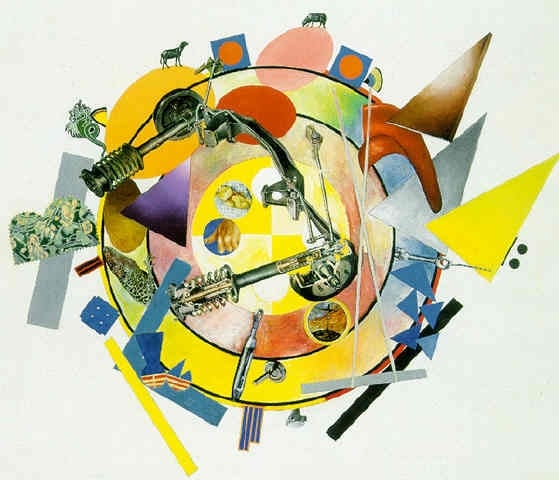
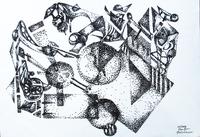
Peter Phillips’ Study for a Constructed Painting is a compelling exemplar of British Pop Art's distinctive engagement with the industrialized image. While American Pop often celebrated or critiqued mass media through iconic, flattened imagery, Phillips brought a uniquely layered, almost architectural approach to the genre. This work, classified as a figurative study, is significant for how it bridges the gap between preparatory process and finished product—a hallmark of Phillips's "constructed" method.
The title itself is revealing: Study for a Constructed Painting signals that the work is not merely a sketch but a deliberate assembly of visual elements. In the context of the 1960s, when Phillips emerged alongside artists like Richard Hamilton and David Hockney, this piece reflects a fascination with the mechanical and the handmade. The "constructed" nature suggests a collage-like sensibility, where figurative forms—likely drawn from commercial imagery, pinball machine motifs, or consumer goods—are fractured and recombined. This process challenges traditional figuration by treating the human figure or its surrogates as modular, depersonalized components, much like the parts of a machine or a advertisement layout.
What makes Study for a Constructed Painting particularly noteworthy is its role as a bridge between Pop's eye-catching surface and its formalist underpinnings. Phillips often used bold primary colors, trompe-l'œil effects, and metallic or glossy finishes to mimic industrial printing. In this study, the viewer can see the artist working out these tensions—balancing the raw energy of pop culture references (e.g., racing stripes, target motifs, or pinball bumpers) with a rigorous, almost Cubist sense of spatial construction. The work therefore stands as a key document of how British Pop Art interrogated the very process of representation: not just what we see, but how we assemble meaning from the visual debris of modern life.
Visually similar
20 works with related composition and palette
The Wheel of Life
Stanley Pinker
Gospel 1
Oleksandr Aksinin
Victory over the Sun: All is well that begins well and has no end
El Lissitzky
Ariette d'oubli de la chapelle étourdie
Suzanne Duchamp
Caliopé
Wols
Orange
Wassily Kandinsky
CQFD
Jaroslav Serpan
The letter scale
Gosta Adrian-Nilsson
DJ Techno
Albert Oehlen
Hanging Form over Water
Graham Sutherland
Brojanje predmeta
Leonid Šejka
Still from Cities of Inextricable Velocities
Ryota Matsumoto
Portrait de Mme. K.
Joan Miro
The level crossing (final state)
Fernand Leger
Landscape with Tractor
Frances Hodgkins
Vajda Lajos Kapu Tányéros Csendélet 1936
Vajda Lajos
The Reverberant Ambience of Interpretative Codes for an Ancient Artifact
Ryota Matsumoto
The slug room
Max Ernst

Surviving in the Multidimensional Space of Cognitive Dissonance
Ryota Matsumoto
Mindsimulacrum
Vannie Gama