Composition
Expert analysis of Henri Michaux’s Composition
Style: Surrealism, Tachisme · Genre: abstract
Expert Analysis of "Composition" by Henri Michaux
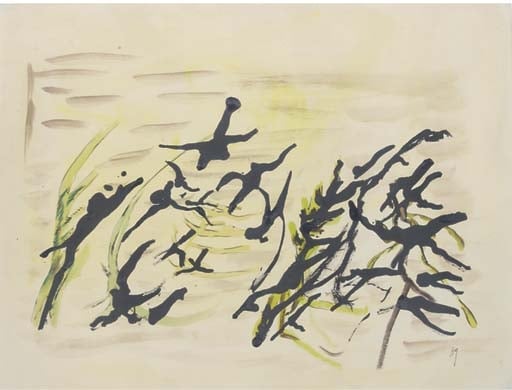
Henri Michaux’s “Composition” stands at a pivotal intersection of Surrealism and Tachisme, two movements that redefined the boundaries of artistic expression in the mid-20th century. As an abstract work, it embodies the artist’s unique approach to automatism and gestural mark-making, making it significant for its bridging of psychological depth with spontaneous materiality.
Surrealist Foundations
Influenced by Surrealism’s emphasis on the unconscious, Michaux’s “Composition” likely emerges from a practice of automatic drawing—a technique prized by André Breton for bypassing rational control. Yet Michaux diverges from classic Surrealist figuration; his imagery is resolutely abstract, focusing on the energy of line and form rather than dreamlike narratives. This abstraction allows the viewer to engage directly with the primordial impulses that drive the composition, aligning with Surrealism’s goal of revealing the inner mind while pushing beyond its traditional iconography.
Tachiste Innovation
Simultaneously, “Composition” anticipates and contributes to Tachisme, a post-war European movement characterized by spontaneous, often blotchy or “stain-like” (tache) applications of paint. Michaux’s engagement with Tachisme is significant because he was both a poet and painter, and his visual works often mimic the rhythm and flow of handwritten script or calligraphic gestures. In this piece, the abstract forms may appear as dynamic, unplanned marks—drips, splatters, or rapid brushstrokes—that prioritize process over representation. This aligns with Tachisme’s rejection of geometric abstraction in favor of a raw, existential immediacy, a hallmark of Art Informel.
Significance in Style and Period
What makes “Composition” notable is how Michaux synthesizes Surrealist automatism with Tachiste materiality, creating an abstract vocabulary that feels both psychologically charged and physically present. His work bridges European Surrealism’s intellectual heritage with the gestural freedom of American Abstract Expressionism and European Informel, all while maintaining a distinctive, poetic sensitivity. In this piece, the artist treats the canvas as a field of action where unconscious impulses become visible—not through recognizable symbols, but through the very texture and rhythm of paint.
Ultimately, “Composition” captures a moment when art moved from the imagery of dreams to the act of making itself, asserting that meaning resides not in what is depicted, but in the visceral, unmediated gesture. Michaux’s contribution lies in proving that abstraction could be as intimate and revelatory as any Surrealist vision, cementing his role as a key transitional figure between two of the 20th century’s most influential movements.
Genre
Style
Visually similar
20 works with related composition and palette
Waving Leaves II
Nikos Hadjikyriakos-Ghikas
Untitled
Emil Schumacher
Untitled
Henri Michaux
Untitled
Paolo Scheggi
Figure at Gerard Beach
Willem de Kooning
Composition
Pierre Tal-Coat
Untitled (Diptych)
Li Yuan-chia
Untitled (Composition)
Afro
Untitled (number drawing)
Craig Kauffman
Number 26
Jackson Pollock
Untitled
Michael Krebber
GE-11
Emil Schumacher
Figure Eight -
Franz Kline
Untitled #77
Friedel Dzubas
Green
Bradley Walker Tomlin
EL-IX
Emil Schumacher
Wind
Willi Baumeister
Gold Stone
Lee Krasner
Amsterdam
Pierre Alechinsky
Composition abstraite
Marcelle Loubchansky