Expertenanalyse zu Henri Michauxs Dessin mescalinien
Stil: Tachisme · Genre: abstract
Expert Analysis of "Dessin mescalinien" (ca. 1954–1959) by Henri Michaux
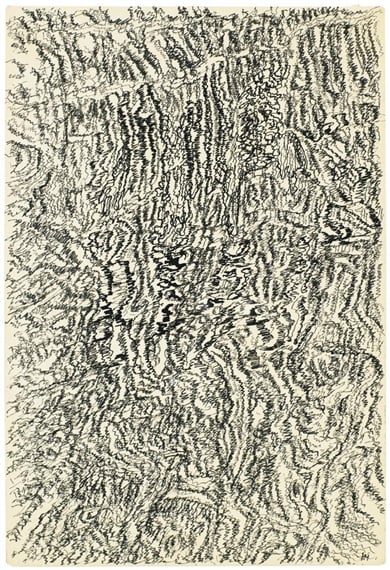
Henri Michaux’s "Dessin mescalinien" stands as a landmark within the Tachisme movement and mid-20th-century abstraction. Executed under the influence of mescaline, the work embodies the Tachiste emphasis on spontaneous, gestural mark-making—a direct, unmediated record of the artist’s inner experience. Where many Tachiste painters (e.g., Wols, Hartung) sought to liberate line from form, Michaux pushes further by harnessing a chemically altered state to dissolve the boundaries between conscious control and pure automatism.
Significance within Tachisme:
- Radical automatism: While Tachisme evolved from Surrealist automatic drawing, Michaux’s mescaline studies go beyond mere spontaneity. The drug-induced visions produce a “graphism of the psyche”—a trembling, pulsing network of lines that seems to map the very energy of perception itself. This aligns with Tachisme’s core aspiration: to make the canvas a field of immediate, unmediated energy rather than a composition.
- Break with lyrical abstraction: Unlike the smooth, elegant gestures of fellow Tachistes, Michaux’s mescaline drawings are jagged, repetitive, almost obsessive—swarms of small strokes, dots, and loops that suggest microscopic turbulence or primordial writing. This shift from “painterly” to “graphic” gives the work a unique, almost calligraphic tension, resonating with East Asian ink traditions that Michaux admired.
- Psychological depth: Michaux famously declared that mescaline “destroys the known world.” Dessin mescalinien therefore functions as a visual diary of consciousness in crisis. Its significance lies in being not just an abstract composition, but a neuroscientific and poetic document—a precursor to later interest in psychedelic art, yet grounded in a rigorous, almost clinical exploration of line as the vehicle for psychic states.
Genre context: As an abstract work, it avoids any reference to recognizable form, instead generating meaning entirely through rhythm, density, and tension. The viewer is confronted with an architecture of anxiety and wonder—a labyrinth of marks that seems to breathe, contract, and scatter. This is Tachisme at its most extreme: painting as a spiritual seismograph.
In summary, Dessin mescalinien is significant because it merges Tachiste gestural freedom with the systematic investigation of altered perception, creating a body of work that questions the very nature of artistic agency. It remains one of the 20th century’s most radical experiments in merging chemical experience, automatic drawing, and abstract expression—a singular fusion that expanded the vocabulary of Tachisme and abstract art.
Visuell ähnlich
20 Werke mit ähnlicher Komposition und Farbpalette
Abstract Series 2003-4-10
Yu Youhan
Bright meteor
Jean Dubuffet
Composition Kewo
Carl Buchheister
Landscape (late autumn)
Alfred Freddy Krupa
Message from a Desert Star
Mark Tobey
The river
Nikos Hadjikyriakos-Ghikas
Paysage 17
Jacques Wadier
Heaven-III
Pratap Singh
After the Harvest
Mark Tobey
Anaglyphic View, Moon Rocks, Stereoscopic Image of Lunar Surface
Nancy Graves
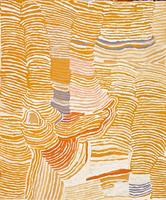
Lupulnga
Makinti Napanangka
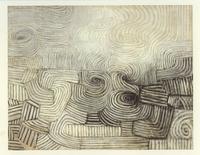
The Snowstorm
Victor Pasmore
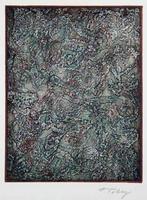
Subtile Souvenir
Mark Tobey
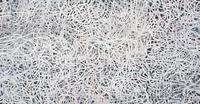
Bush Yam Dreaming
Emily Kame Kngwarreye
Untitled
Germaine Richier
Untitled
Simon Hantai
Natashkouan
Marcel Barbeau
Composition
Hryhorii Havrylenko
Quarzeat
Cy Twombly
T80-36
Johannes Jan Schoonhoven