Expert analysis of Julio Pomar’s Edgar Poe, Charles Baudelaire, Um Orangotango e o Corvo
Style: Neo-Expressionism · Genre: portrait
Expert Art Historical Analysis: "Edgar Poe, Charles Baudelaire, Um Orangotango e o Corvo" by Julio Pomar
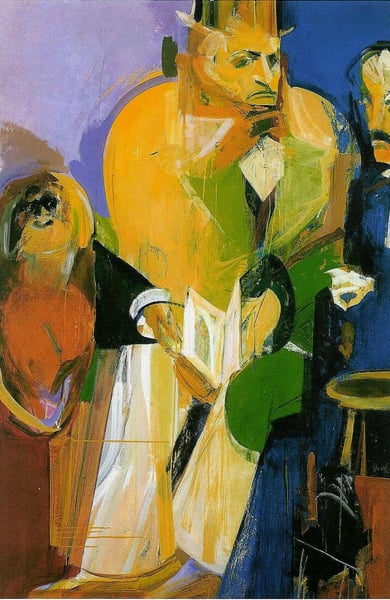
Julio Pomar’s Edgar Poe, Charles Baudelaire, Um Orangotango e o Corvo (Edgar Poe, Charles Baudelaire, an Orangutan and the Raven) is a compelling example of Neo-Expressionist portraiture that collapses literary biography, psychological unease, and animalistic symbolism into a single, charged composition. Painted by the Portuguese modernist (1926–2018), the work reflects the Neo-Expressionist impulse to reassert emotional directness, narrative complexity, and raw painterly gesture—qualities that distinguish the movement from the cool conceptualism and minimalism that preceded it.
Stylistic Significance within Neo-Expressionism
Neo-Expressionism emerged in the late 1970s and 1980s as a return to figurative, often aggressive mark-making, subjective emotion, and historical or literary allegory. Pomar, though older than many of the movement’s German and Italian stars (e.g., Georg Baselitz, Anselm Kiefer, Francesco Clemente), aligns with its core tenets: exaggerated forms, dissonant color, and a psychological depth that rejects photorealism. In this portrait, Pomar distorts anatomy and perspective—faces and bodies seem to warp under internal pressure—while thick, gestural brushwork creates a sense of urgency. The canvas becomes a psychological battlefield, not an objective likeness.
Thematic Analysis of the Portrait’s Subjects
The title explicitly names four entities: Edgar Allan Poe, Charles Baudelaire, an orangutan, and a raven. This is not a conventional portrait of two writers. Instead, Pomar fuses Poe’s and Baudelaire’s literary identities with the creatures from their work—the raven from Poe’s poem and the orangutan from The Murders in the Rue Morgue. Baudelaire, a fervent translator and admirer of Poe, is thus depicted as a spiritual and intellectual double. The orangutan and raven serve as non-human manifestations of the writers’ dark romanticism: the raven as symbol of mourning and madness, the orangutan as the embodiment of primal, irrational violence. By placing all four in one frame, Pomar compresses a web of literary references into a single, Neo-Expressionist “portrait” of the creative, tormented soul.
What Makes the Work Significant
This painting is significant because it defies the conventional boundary between portrait and narrative history painting. It does not merely depict individuals but visualizes the symbiotic relationship between writer, translator, and the monstrous creatures of their imagination. Within Neo-Expressionism, such works often aim to resurrect the grand themes of myth, history, and literature that had been sidelined by post-war abstraction. Pomar’s use of exaggerated, almost caricatured features—for example, the raven’s beak or the orangutan’s menacing posture—heightens the emotional stakes, making the viewer confront the darker undercurrents of creation. The work stands as a testament to Neo-Expressionism’s capacity to fuse personal, literary, and psychological content, all while prioritizing expressive force over naturalistic accuracy. In doing so, Pomar aligns himself with the movement’s broader ambition: to reclaim painting as a vehicle for profound, unsettling human truth.
Genre
Style
Visually similar
20 works with related composition and palette
Self Portrait
George Bouzianis
Three Welsh Miners
Josef Herman
Arnold Schönberg
Oskar Kokoschka
Arne Cederholm Med Modellen
Magnus Enckell
Portrait of the sculptor P. Bromirsky
Pyotr Konchalovsky
Henri Rouart and His Son Alexis
Edgar Degas
Count Weilhorski
Amedeo Modigliani
Hans Tietze and Erica Tietze-Conrat
Oskar Kokoschka
Father and son
George Bouzianis
Portrait of Heinrich Benesch
Egon Schiele
Franz Hauer
Oskar Kokoschka
Czóbel Önarckép
Bela Czobel
Portrait of Wilhelm Uhde
Pablo Picasso
Munkás Fiú
Bela Czobel
The young apprentice
Amedeo Modigliani
Czóbel Béla. .
Bela Czobel
Camões
Julio Pomar
Man Smoking a Pipe
Paul Cezanne
Homme Assis
Henri Matisse
The beggar of Livorne
Amedeo Modigliani