Expert analysis of Mario Cesariny’s O Operário
Style: Automatic Painting · Genre: abstract
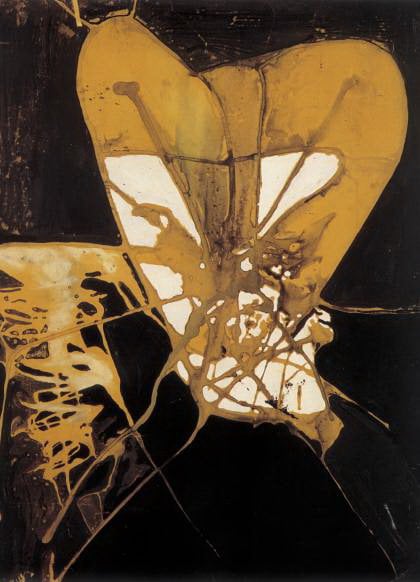
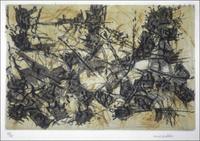
Mário Cesariny’s O Operário (The Worker) stands as a compelling example of automatic painting within the broader Surrealist movement, particularly in its Portuguese context. Executed in an abstract idiom, the work embodies the Surrealist principle of automatisme—a technique in which the artist suppresses rational control to allow the subconscious to guide the hand. This method was central to Surrealism’s goal of accessing the raw, unfiltered psyche, and Cesariny, a leading figure of the Portuguese Surrealist group (the Grupo Surrealista de Lisboa), championed it as a means of political and existential liberation.
The title O Operário introduces a deliberate tension between the abstract form and the concrete, social referent of “the worker.” By using automatic, non-representational marks, Cesariny subverts traditional heroic depictions of labor. Instead of a figurative portrait, the painting evokes the inner life, struggles, or collective unconscious of the proletariat through spontaneous gestures, splatters, and amorphous shapes. This aligns with Surrealism’s interest in merging psychological depth with social critique. The work’s significance lies in how it harnesses automatism to deconstruct conventional imagery, proposing that the worker’s identity is not fixed but emerges from instinctual, pre-rational expression. In the context of mid-20th-century Portugal, under the authoritarian Estado Novo regime, Cesariny’s automatic abstraction also functioned as a form of resistance—a refusal of prescribed order and a valorization of creative freedom as a political act. O Operário thus occupies a unique intersection of Surrealist technique, abstract aesthetics, and anti-authoritarian commentary, marking Cesariny as a vital innovator in both Portuguese art and the international Surrealist avant-garde.
Genre
Style
Visually similar
20 works with related composition and palette
Untitled
Claude Georges
Sem título
Mario Cesariny
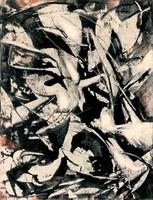
Untitled
Karl Otto Gotz
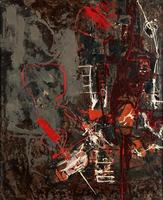
Untitled
Claude Georges
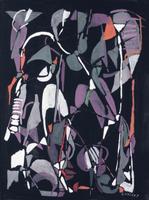
Composition-
Andre Lanskoy
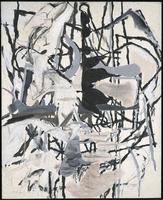
Early Morning Garden
Perle Fine
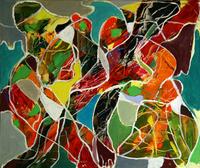
The Brawl
Romul Nutiu
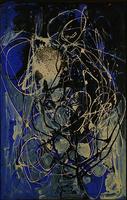
The Wind
Hans Hofmann
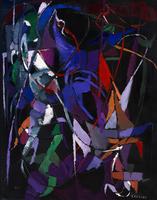
L'eclair magique
Andre Lanskoy
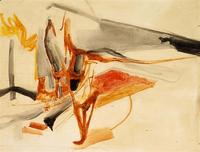
Composition
Huguette Arthur Bertrand
Nero, verde, azzurro
Afro
Improvisation (Dreamy)
Wassily Kandinsky
MR-6
Conrad Marca-Relli
Composition on the yellow
Istvan Molnar
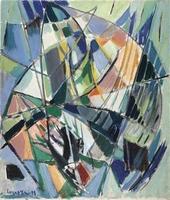
Untitled
Antonio Corpora
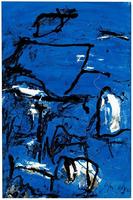
Cuma
Emil Schumacher
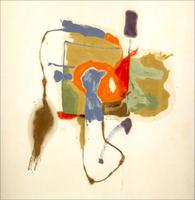
Blue Form in a Scene
Helen Frankenthaler
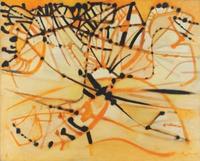
Alpilles orange
Mario Prassinos
Constructions chimériques
Jean-Paul Riopelle
Gamla staden, opus 5
Richard Mortensen