Экспертный разбор работы «O Papá que veio de Leste» художника Mario Cesariny
Стиль: Surrealism · Жанр: abstract
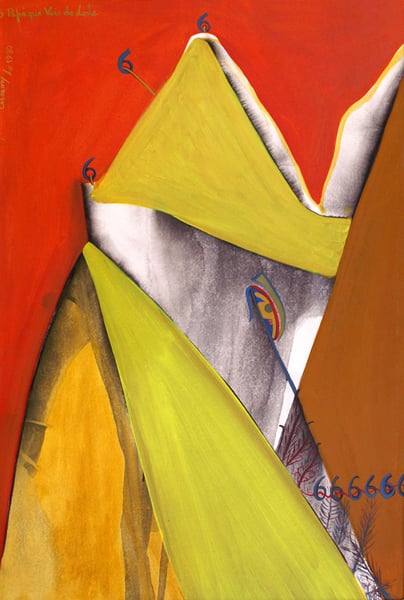
Expert Art Historical Analysis: O Papá que veio de Leste (The Father Who Came from the East) by Mário Cesariny
Significance within Surrealism and Period Context
Mário Cesariny (1923–2006) was the leading figure of the Portuguese Surrealist movement, and O Papá que veio de Leste stands as a vital example of how Surrealism was reimagined outside its Parisian epicenter. This abstract work, executed in a style that prioritizes automatism and symbolic liberation over recognisable forms, embodies Surrealism’s core mission: to bypass rational control and tap the unconscious.
Key Characteristics Defining its Significance
-
Abstract Surrealism / Automatism: Cesariny, like many postwar European Surrealists, moved toward non-representational imagery to escape the tyranny of the object. In this painting, the absence of a literal father figure or Eastern landscape forces the viewer into a purely associative experience. The title — “The Father Who Came from the East” — suggests a personal, perhaps political or psychoanalytic narrative, yet the abstraction denies any single reading. This tension between title and image is a hallmark of Cesariny’s work, inviting multiple subconscious interpretations.
-
Portuguese Context and Political Undertones: Cesariny was an anti-fascist activist during the Estado Novo dictatorship. “The East” may allude to Eastern Europe or the Soviet Union, but also to the mythical East of Surrealist desire. The ‘father’ could represent authority, tradition, or the imposing patriarchal state. By rendering this figure abstract, Cesariny challenges totalitarian certainty, replacing dogma with fluid, irrational form. This aligns Surrealism with resistance — a key aspect of its post-1945 significance.
-
Expressive Plastic Language: The work’s abstract genre is not a rejection of content but a search for new content. Cesariny’s dynamic compositions, often built on calligraphic lines, organic blots, and biomorphic shapes, evoke the automatic writing of André Breton’s manifestos. O Papá que veio de Leste likely employs a gestural, spontaneous technique, making the very act of creation a demonstration of liberated consciousness.
Conclusion
This artwork is significant because it localizes Surrealism’s universal ambition — to dismantle rationality — within Portugal’s specific cultural and political realities. As an abstract piece, it pushes Surrealist theory into a realm where the unconscious speaks without the crutches of narrative or figurative allegory. Cesariny’s O Papá que veio de Leste is thus a bold statement that Surrealism’s revolutionary potential lives not in recognizable dreams, but in the pure, unbridled form of the abstract.
Жанр
Стиль
Визуально похожие
20 работ с близкой композицией и палитрой
Architectonic Painting
Lyubov Popova
038 Le Court Métrage
Genis Remacha
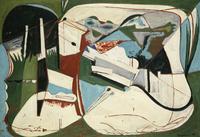
Landscape of Olympia
Yiannis Tsaroychis
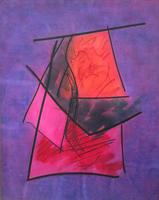
Imago
ambrosio
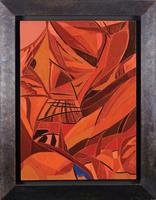
Untitled
Nikias Skapinakis
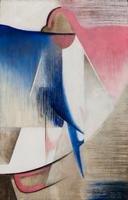
Child with Boat
Marthe Donas
Your kingdom come
Linde Martin
Sborul păsărilor
Ion Pacea
Colored Rhythm: Study for the Film
Leopold Survage
L'Unique III
Bram van Velde
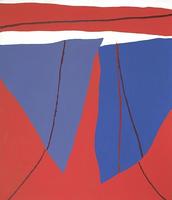
Spring
Ray Parker
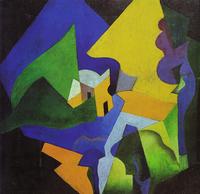
Costruzione spaziale - paesaggio
Enrico Prampolini
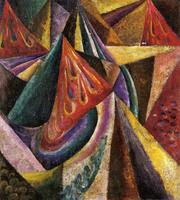
Abstract Composition
Oleksandr Bogomazov
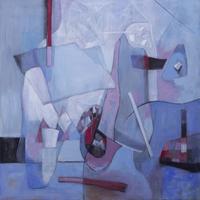
Початок Сну (The beginning of a dream)
Артемій Присяжнюк
Monde nostalgique #3
Jean-Paul Jerome
Abstract composition
Florin Maxa
Untitled
Jean-Paul Jerome
Painterly-Architectonic
Lyubov Popova
Bild
Pablo Picasso
Blue and Green Music
Georgia O'Keeffe