Expert analysis of Mario Cesariny’s Rumeurs des villes
Style: Abstract Expressionism · Genre: abstract
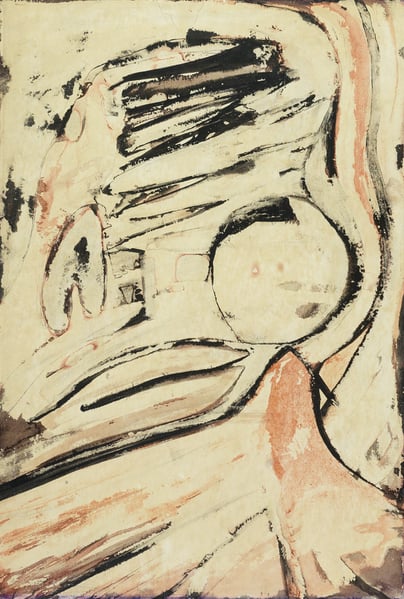
Expert Analysis: "Rumeurs des villes" by Mario Cesariny
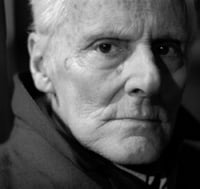
Mario Cesariny (1923–2006) is best known as a leading figure of the Portuguese Surrealist movement, but his forays into Abstract Expressionism reveal a vital, lesser-known dimension of his practice. “Rumeurs des villes” (English: “Rumors of the Cities”) stands as a compelling example of how Cesariny transplanted the emotional immediacy and gestural freedom of American Abstract Expressionism into a distinctly European, even urban, sensibility.
Significance within Abstract Expressionism
What makes this work significant is its synthesis of automatism—a core Surrealist technique Cesariny mastered—with the all-over composition and energetic mark-making central to Abstract Expressionism. Where many Abstract Expressionists (like Pollock or de Kooning) sought a primal, mythic or nature-inspired chaos, Cesariny’s title “Rumeurs des villes” explicitly anchors the abstraction in the sensory cacophony of modern urban life. The “rumors” suggest fragmented, overheard voices, traffic, neon signs, and the layered dissonance of the city, translated into brushstrokes and color fields rather than literal representation.
The painting likely employs a non-representational vocabulary of sweeping, agitated lines, drips, and blocked colour patches that evoke the tempo and density of a metropolis. This is significant because it demonstrates how Abstract Expressionism could be adapted to convey collective urban experience rather than purely personal or existential angst. Cesariny’s background in poetry and Surrealism further enriches the work’s semantic ambiguity: the abstract forms function as visual equivalents of spoken rumors—half-heard, shifting, impossible to pin down.
Art-Historical Context
Within the broader movement, “Rumeurs des villes” is notable as a transnational contribution to Abstract Expressionism. While the style is often associated with New York School artists, Cesariny’s work shows its relevance to European artists wrestling with postwar urban alienation and the residue of Surrealist practice. His choice of an abstract language to capture “city rumors” also prefigures later developments in lyrical abstraction and the blending of textuality with painting.
In summary, the significance of “Rumeurs des villes” lies in its fusion of Abstract Expressionist gesture with Surrealist automatism and urban thematics, creating a work that is both an authentic document of its time and a unique—often overlooked—bridge between two major avant-gardes.
Visually similar
20 works with related composition and palette
Arabesque - by BenFo
Fons Heijnsbroek
Night
Willem de Kooning
Mi.R Bb2
MAURIZIO D'ANDREA
Mi.R Bb20
MAURIZIO D'ANDREA
Byzantine Faces
George Stefanescu
1 August 1948
Frank Lobdell
Armageddon
Artin Demirci
Armageddon
Artin Demirci
Mi.R Bb16
MAURIZIO D'ANDREA
Fire Island
Willem de Kooning
Calypso II
Jean-Michel Atlan
Mi.R Bb42
MAURIZIO D'ANDREA
ORBITA CERCANA
Manuel Felguérez
Sorrow, Leaning Woman
Volodymyr Loboda
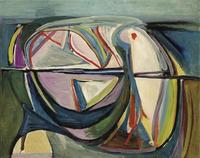
Untitled
Bram van Velde
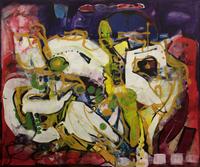
Armageddon
Artin Demirci
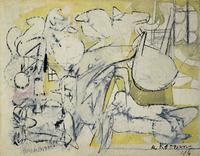
Special Delivery
Willem de Kooning
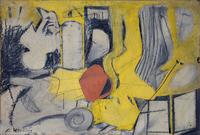
Secretary
Willem de Kooning
Large Abstract Seascape with Diagonal - 1989 - painting by Fons Heijnsbroek - Dutch artist
Fons Heijnsbroek
Untitled
Andre Lanskoy