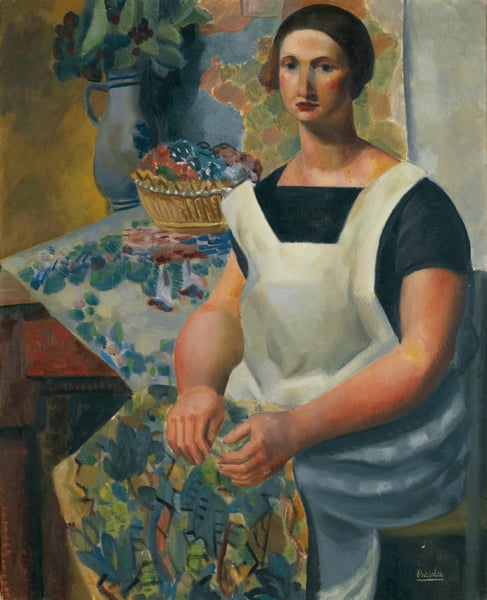
Tapestry (Portrait of Madame Bissière)
Экспертный разбор работы «Tapestry (Portrait of Madame Bissière)» художника Roger Bissière
Стиль: Post-Impressionism · Жанр: portrait
Roger Bissière’s Tapestry (Portrait of Madame Bissière) is a remarkable fusion of post-impressionist sensibility with the ancient craft of tapestry, marking a significant departure from conventional portraiture. Although no visual description is provided, the work’s importance can be understood through its medium and stylistic context.
Significance within Post-Impressionism:
Bissière aligns with the post-impressionist emphasis on structure, emotional expression, and subjective color—principles championed by Cézanne, Gauguin, and van Gogh. In translating a portrait into a woven tapestry, he rejects straightforward naturalism for a deliberate, almost architectural arrangement of form. The tapestry’s grid-like warps and wefts naturally break the image into discrete patches of color and texture, echoing the post-impressionist device of using separate, rhythmic touches of pigment to build volume and atmosphere. This technique parallels pointillism’s optical mixing and Gauguin’s flat, symbolic color fields.
Innovative Medium:
By choosing tapestry, Bissière elevates a decorative art to the level of fine art—a move that resonates with the post-impressionist desire to blur boundaries between craft and painting. The portrait of his wife, Madame Bissière, becomes not merely a likeness but a tactile, fabric-based exploration of line, color, and surface. The woven medium imposes a formal discipline that strips away incidental detail, forcing the viewer to focus on essential relationships: the tension between warm and cool hues, the vertical-horizontal logic of the weave, and the way thread can suggest both contour and mass.
Art Historical Legacy:
Bissière’s tapestry portraits helped revive interest in woven art in early 20th-century France, prefiguring the later fusion of abstraction with textile in the École de Paris. In this single work, he demonstrates how post-impressionism’s liberation of color and form can be achieved not only with oil paint but with the enduring, intimate language of thread.
Визуально похожие
20 работ с близкой композицией и палитрой
Falusi Utca
Bela Czobel
Girl with Red Shawl
Bela Czobel
The farmers daughter
William Henry Hunt
Margareta Drawing (Girl of the Author)
Stefan Dimitrescu
The shy child
Nicolaas van der Waay
Breton Woman
Olga Boznańska
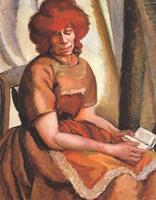
Redheaded Woman Reading
Tamara de Lempicka
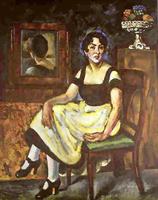
Portrait of a Woman with mirror
Ilya Mashkov
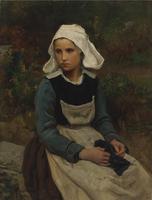
Young Brittany girl knitting
Jules Breton
The Girl in the Cantine for Pilots
Felicien Rops
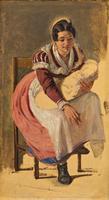
'Roman Woman with a Child (study for 'The St. Anthony Feast Day in Rome')
Wilhelm Marstrand
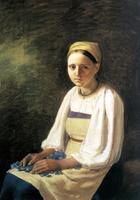
Girl with the Cornflowers
Alexey Venetsianov
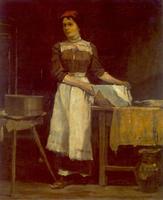
Bolting Girl
Janos Tornyai
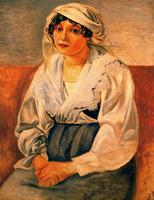
Italian girl
Andre Derain
Professional Nurse
John French Sloan
Irish Lass
Robert Henri
The Pretty Housewife
Amedeo Modigliani
Maid in uniform
Irma Stern
Lucy Hill
Arthur Hughes
Scheveningen Woman Sewing
Vincent van Gogh