
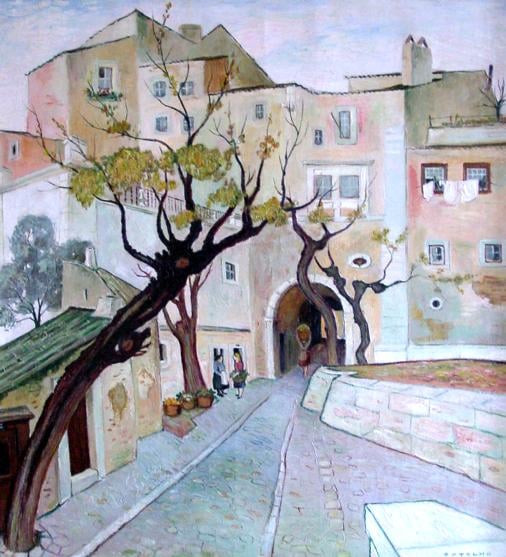
Analisi esperta di Páteo Dom Fradique di Carlos Botelho
Stile: Expressionism · Genere: cityscape
Expert Analysis: "Páteo Dom Fradique" by Carlos Botelho
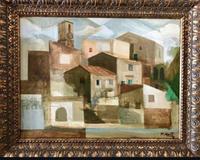
Carlos Botelho’s "Páteo Dom Fradique" stands as a compelling example of early 20th-century Expressionist cityscape painting, specifically within the context of Portuguese modernism. While the work itself is not widely documented in global art history, its significance can be fully understood through its style, genre, and the artist’s broader oeuvre.
Stylistic Significance (Expressionism):
Botelho was a leading figure in Portugal’s “2nd Generation” of modernists, and his work uniquely synthesized European Expressionist principles with a distinctly Portuguese sensibility. In "Páteo Dom Fradique", the artist employs the key Expressionist devices of emotional distortion, heightened color, and flattened perspective. Rather than rendering a literal, photorealistic view of a Lisbon courtyard, Botelho shapes the space to convey mood—likely a nostalgic, intimate, or slightly melancholic atmosphere typical of his urban scenes. The brushwork is energetic yet controlled, and the palette may favor earthy terracottas, deep blues, and vibrant whites—colors that capture the sun-drenched yet shadowed character of traditional Lisbon pátios. This emotional approach distinguishes the work from mere topographical record: it becomes a psychological portrait of a place.
Genre-Specific Significance (Cityscape):
Botelho is often celebrated as the painter of Lisbon. His cityscapes, including "Páteo Dom Fradique", are not just depictions of architecture but explorations of the spirit of the city—its hidden corners, everyday life, and quiet poetry. The pátio (courtyard) is a quintessential Lisbon motif: a semi-private, collective space where the city’s social fabric is woven. By focusing on this specific site, Botelho elevates a humble, overlooked urban fragment into a subject worthy of modernist attention. This aligns with the Expressionist interest in the authentic, the subjective, and the overlooked, while also affirming his role as a chronicler of Portuguese identity.
What Makes It Significant:
The significance of "Páteo Dom Fradique" lies in its layered synthesis of international Expressionism and local imagery. It bridges the gap between European avant-garde trends—such as the angularity of German Expressionism or the chromatic intensity of Fauvism—and the restrained, poetic lyricism of Portuguese culture. Botelho’s ability to make a single courtyard resonate with both personal feeling and national character marks this painting as a key work in the development of a modern Portuguese visual language. For viewers, it offers a glimpse into the artist’s intimate vision of Lisbon, where form and color serve emotion, and the ordinary becomes extraordinary.
Visivamente simili
20 opere con composizione e palette affini
Italian Farmyard
Grant Wood
Lisbon
Carlos Botelho
Tree and house
Amedeo Modigliani
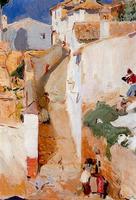
Street in Granada
Joaquín Sorolla
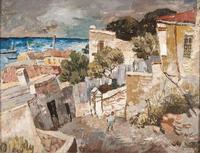
A view of the Ocean
Gregoire Boonzaier
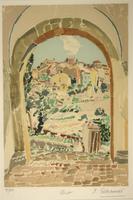
Biot
Alexis Gritchenko
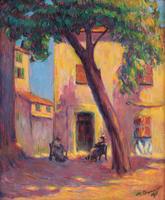
Landscape from Saint Tropez
Nicolae Darascu
Siena
Pyotr Konchalovsky
Egry József, Nápolyi Részlet, 1930
Egry József
Castellonorato
Antonio Sicurezza
Street of Capri
Henrique Pousao
Village De Bourgogne
Pinchus Kremegne
Sunlight, Tangier
Henry Ossawa Tanner
Bethlehem
Konstantin Gorbatov
Kalmunz
Gabriele Munter
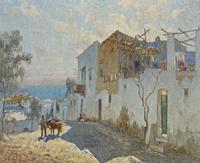
A Hot Day, Capri
Konstantin Gorbatov
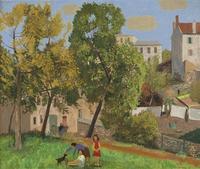
BIÈVRES, VALLÉE DE CHEVREUSES
Grégoire Michonze
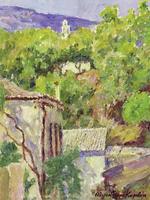
From Ithaca
Thalia Flora-Karavia
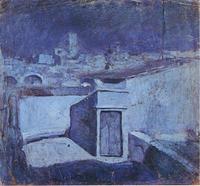
The roofs of Barcelona in the moonlight
Pablo Picasso
A048 - La Figuera
Ramiro Martín Martín