Columbano Bordalo Pinheiro sanatçısının Um Concerto de Amadores eseri hakkında uzman analizi
Tarz: Realism · Tür: genre painting
Expert Analysis of "Um Concerto de Amadores" by Columbano Bordalo Pinheiro
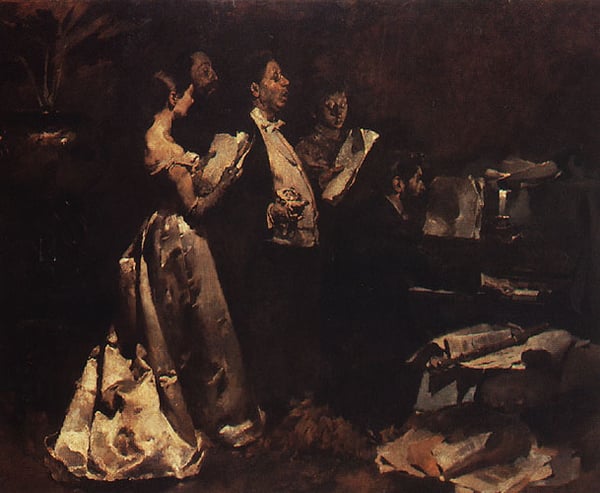
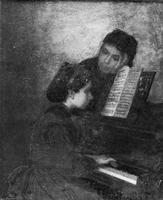
Columbano Bordalo Pinheiro’s “Um Concerto de Amadores” (c. 1882) stands as a masterful testament to Portuguese Realism, a movement that sought to depict contemporary life with unflinching honesty and psychological depth. Painted at a time when European art was increasingly drawn to the quotidian, this work exemplifies the Realist commitment to capturing the private, unheroic moments of bourgeois society—here, a small, intimate gathering of amateur musicians.
Stylistic and Technical Significance
Executed in a subdued, earthy palette dominated by deep browns, muted ochres, and warm shadows, the painting reflects Columbano’s debt to both Spanish Baroque masters (especially Velázquez) and the tonal realism of Manet. The composition is deliberately untheatrical: figures are clustered around a piano and string instruments, each absorbed in the act of making music. Their faces are not idealized; rather, Columbano renders them with keen observational precision—furrowed brows, concentrated gazes, the slight awkwardness of amateur performance. This focus on individual psychology over melodrama is a hallmark of Realist genre painting, elevating a simple domestic scene into a study of human dedication and vulnerability.
Genre Painting as Social Document
Within the tradition of genre painting, “Um Concerto de Amadores” offers a quiet critique of the Romantic notion of the artist-genius. By depicting amateurs—presumably members of Lisbon’s cultured middle class—Columbano champions a democratic view of artistic expression. The painting’s significance lies in its refusal to sensationalize; instead, it validates the dignity of everyday cultural practice. The dim, lamp-lit interior and the figures’ self-contained absorption create a hushed, almost reverential atmosphere, inviting the viewer to contemplate the fleeting beauty of shared, imperfect artistry.
Context and Legacy
Columbano Bordalo Pinheiro (1857–1929) was a leading figure in the “Grupo do Leão,” a circle of Portuguese realist artists who rebelled against academic sentimentalism. “Um Concerto de Amadores” exemplifies his ability to merge naturalistic detail with a profound sense of stillness and intimacy, a quality that distinguishes his work from more narrative-driven genre scenes of the era. Today, the painting is regarded as a key work in the history of Portuguese Realism, revealing how the genre painting tradition could serve as a window into the social and emotional textures of a specific time and place—capturing not just a concert, but the quiet pulse of a society’s inner life.
Stil
Görsel olarak benzer
İlişkili kompozisyon ve renk paletine sahip 20 eser

The Pathetic Song
Thomas Eakins
Sketch for the Pathetic Song
Thomas Eakins

The piano. Portrait of S.V. Tarnovskaya
Ilya Repin
Schubert at the Piano II
Gustav Klimt
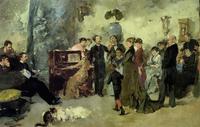
O Serão
Columbano Bordalo Pinheiro
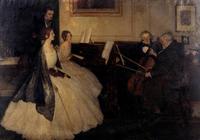
The Rehearsal
Leonard Campbell Taylor
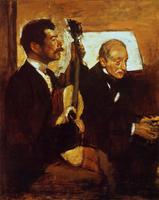
Degas' Father Listening to Lorenzo Pagans Playing the Guitar
Edgar Degas

Literary meeting
Stefan Luchian
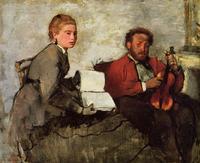
Violinist and Young Woman
Edgar Degas
Music in the Studio
Gunnar Berndtson
Revue
Everett Shinn
Leaving the Theater
Constantin Guys

The Duet
Luke Fildes
Two women at the piano
Giovanni Boldini
Chopin Performing in the Guest-Hall of Anton Radziville in Berlin in 1829
Henryk Siemiradzki
Outdoor Stage, France
Everett Shinn
M. and Mme Edouard Manet
Edgar Degas
Sertine School
Domenico Induno
At the Piano
Thomas Eakins

Schubertiade
Julius Schmid