
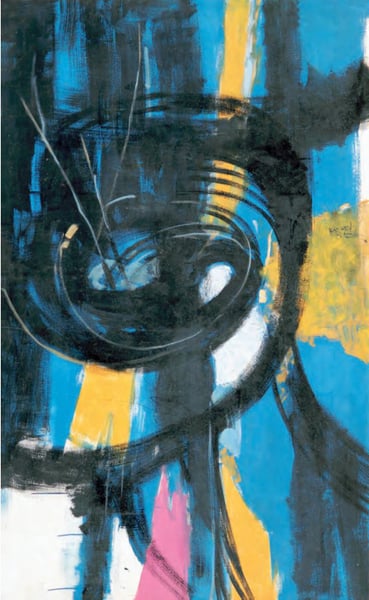
Abstract
Analisi esperta di Abstract di Basuki Abdullah
Stile: Abstract Expressionism · Genere: abstract
Expert Analysis: "Abstract" by Basuki Abdullah
While Basuki Abdullah is predominantly known for his realist and romantic figurative works—often celebrating Indonesian landscapes, portraits, and classical themes—his piece titled "Abstract" represents a striking departure into Abstract Expressionism, a movement historically dominated by American and European artists. This work’s significance lies precisely in its cross-cultural adoption of a mid-20th-century Western avant-garde idiom by a Southeast Asian master, challenging the notion that Abstract Expressionism was a purely Western phenomenon.
Significance within the Abstract Expressionist Movement
-
Globalizing the Gesture
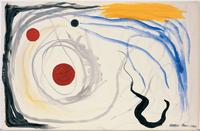
Abstract Expressionism is defined by its emphasis on spontaneous, gestural mark-making and the conveyance of raw emotion through non-representational means. In "Abstract", Abdullah likely employs the hallmarks of the style—energetic brushwork, visceral color contrasts, and a sense of unmediated personal expression—but filtered through an Indonesian sensibility. This global reinterpretation expands the movement’s historical boundaries, demonstrating that its principles of freedom and subjectivity could transcend cultural contexts. -
The Artist’s Bold Formal Shift
Abdullah’s career was rooted in academic realism and seductive, lyrical imagery. By creating an abstract work, he deliberately subverts his own established strengths. This makes "Abstract" significant as a testament to artistic range: it shows that even a master of representation could embrace total abstraction, thereby validating the movement’s core belief that an artwork’s emotional truth need not rely on recognizable forms. -
Title as Conceptual Statement
The generic title "Abstract" is itself a declaration. In the Abstract Expressionist canon, works are often given evocative or neutral names to avoid anchoring the viewer’s interpretation. Abdullah’s choice to simply label the work with its genre foregrounds the purely formal and expressive content—color, line, texture, rhythm—as the sole subjects. This aligns with the movement’s rejection of narrative or symbolic meaning in favor of the immediate, physical experience of painting. -
Contribution to a Non-Western Abstract Expressionism
The work stands as an important artifact of global modernism. While Abstract Expressionism flourished in New York in the 1940s–50s, artists like Abdullah in Indonesia adapted its language to express their own cultural and emotional realities. "Abstract" thus bridges artistic worlds, proving that the movement’s ethos of radical individual expression could be a universal tool, not a proprietary Western style.
Conclusion
Basuki Abdullah’s "Abstract" is significant not for its formal novelty within the global Abstract Expressionist tradition (though its use of gestural abstraction is likely accomplished), but for its role in extending the movement’s geographic and cultural reach. It challenges viewers to see Abstract Expressionism not as a closed historical chapter but as a living, adaptive mode of expression—one that could be claimed by an Indonesian master who had already mastered the opposite aesthetic pole. In this sense, the work is a quiet yet powerful statement about the universality of artistic freedom.
Genere
Visivamente simili
20 opere con composizione e palette affini

Crescendo
Ernst Wilhelm Nay

Mi.R Bb42
MAURIZIO D'ANDREA

Untitled
Luigi Guardigli
Untitled
Karl Otto Gotz
Circle Image
Louis Schanker

1 August 1948
Frank Lobdell

Composition
Janos Mattis-Teutsch

Arabesque - by BenFo
Fons Heijnsbroek
Untitled
Karl Otto Gotz

Untitled
Luigi Guardigli

Mahogany Road
Mary Abbott

Agway
James Brooks
Untitled
Alexander Calder

Rythme bleu
Jean Miotte

The fight
Linde Martin

Untitled
Luigi Guardigli

Composition
Serge Brignoni

Untitled
Karl Otto Gotz

Untitled
Karl Otto Gotz

Distance Finding Mozart
Paul Jenkins