
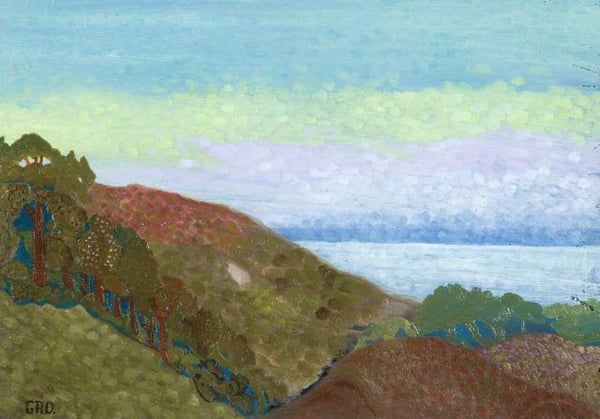
Analisi esperta di Paysage du Midi di Georges Ribemont-Dessaignes
Stile: Pointillism · Genere: landscape
Expert Analysis of Paysage du Midi by Georges Ribemont-Dessaignes
Context & Significance within Pointillism
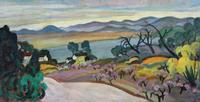
Although Georges Ribemont-Dessaignes is best remembered for his radical Dada performances and writings, Paysage du Midi stands as an intriguing outlier within his oeuvre—and within Pointillist practice itself. Executed in the disciplined, scientific dots of Neo-Impressionism, the work adopts the signature technique of Seurat and Signac, yet it emerges from an artist who would soon mock the very conventions of painting. This tension makes the piece significant: it represents a moment when a future Dada provocateur still engaged seriously with the rigorous color theory of the late 19th century, demonstrating that Pointillism’s optical mixing could appeal even to those who would later dismantle artistic tradition.
Technical and Stylistic Observations
True to the Pointillist method, the landscape is built from countless discrete touches of pure pigment. The choice of Midi (southern France) is archetypal for the movement—the brilliant Mediterranean light and intense heat provided ideal conditions for exploring simultaneous contrast and the decomposition of sunlight into spectral hues. Ribemont-Dessaignes likely employed a vibrant palette of cadmium yellows, cobalt blues, and vermilions, juxtaposing complementary colors (e.g., orange-roofed villas against blue-violet shadows) to create a shimmering, luminous surface. The composition probably follows a classic Neo-Impressionist schema: a horizontal band of sea or plain, a middle ground of trees or architecture, and a sky broken by atmospheric dots. Yet, even within this orthodox framework, one senses a slight restlessness—a hint of the artist’s later irreverence in perhaps exaggerated dot sizes or unexpected color accents that push the scene toward near-abstraction.
What Makes It Significant
- A Bridge Between Movements: Paysage du Midi is a rare and valuable document of an artist who straddled the tail end of Post-Impressionism and the dawn of the avant-garde. It shows that Pointillism, far from being a dead end, continued to influence artists who would soon subvert it. For Ribemont-Dessaignes, mastering this meticulous technique likely gave him the technical vocabulary to later parody it in Dada works.
- Light as Structure: The painting exemplifies how Pointillism treats light itself as the subject. Rather than describing forms through line, the artist relies entirely on optical fusion to conjure a sense of depth and atmosphere. The heat and stillness of a southern summer day are rendered not through anecdote but through the vibration of color dots alone.
- Ambiguity of Artist’s Intent: Because Ribemont-Dessaignes is not a canonical Pointillist, the work raises questions: Is it a sincere homage to Seurat? A student exercise? Or an ironic adoption of a “stuffy” style that the artist later rejected? This ambiguity adds a layer of conceptual significance, making the landscape as much about artistic identity as about the view itself.
Placement in Art History
While not a breakthrough on the scale of Seurat’s Sunday Afternoon on the Island of La Grande Jatte, Paysage du Midi enriches our understanding of Pointillism’s reach. It proves that the style persisted beyond its orthodox practitioners and could be taken up by figures who ultimately defined the subsequent rupture of Dada. The work thus stands as a quietly radical artifact: a serene landscape painted by a future provocateur, reminding us that even the most disruptive artists often begin by mastering the very traditions they later overturn.
Visivamente simili
20 opere con composizione e palette affini
Landscape near Cassis
Andre Derain
Seascape
Horace Trenerry
Vermont Hills
Milton Avery
Morocco
Nicholas Roerich
Mountain slope
Koloman Moser
View of monte Acuto
William Balthazar Rose
Green Sea
Milton Avery
Lake Hyumpola
Nicholas Roerich
Sunrise
Fujishima Takeji
Gaspe Pink Sky
Milton Avery
Night Landscape
Pierre Bonnard
Hillock
Fred Williams
View from Mount Asama in Ise
Fujishima Takeji
Landscape
Andre Derain
Lake Ladoga Islands
Nicholas Roerich
Evening mist on Lake Thun
Ferdinand Hodler
Composition #22
Yuri Zlotnikov
Egry József, Badacsony,.
Egry József
Paysage aux deux figures
Pablo Picasso
Spring Dawn on the South Bank of river
Guan Zilan