
Expert analysis of Joan Snyder’s Rose Garden
Style: Abstract Expressionism · Genre: abstract
Analysis of "Rose Garden" by Joan Snyder
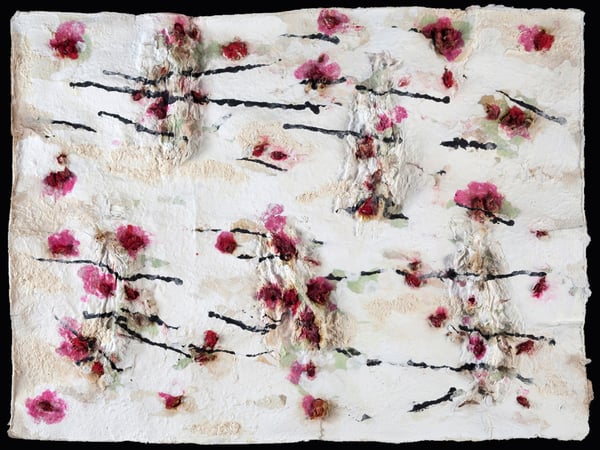
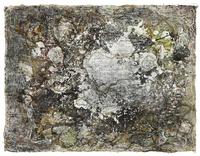
Joan Snyder’s Rose Garden stands as a compelling example of late Abstract Expressionism, reimagined through a distinctly feminist and material-intensive lens. Within the broader context of the movement—often dominated by grand, heroic gestures—Snyder’s work asserts a more intimate, tactile, and narrative-driven abstraction.
Stylistic and Technical Signature
Snyder is known for her dense, layered surfaces built from thick impasto, fabric, and sometimes text. In Rose Garden, this manifests in a riot of visceral marks: swirling, almost calligraphic strokes that evoke petals, thorns, and organic growth. The palette likely ranges from deep reds and greens to muddy browns and whites, creating a tension between lushness and decay. Rather than the all-over composition of a Pollock, Snyder uses a centered, aggregated form—a “garden” that feels both extracted from nature and invented. The paint is not just applied but built, scratched, and smeared, giving the surface a raw, embodied presence.
Significance within Abstract Expressionism
Snyder belongs to the second generation of Abstract Expressionists, a cohort that reacted against the “triumphant” individualism of the first wave. Her work is significant because it introduces a personal, often autobiographical vocabulary into pure abstraction. Rose Garden is not a literal depiction of flowers but an emotional landscape—a meditation on growth, memory, and the female body. The “rose” functions as a symbol of beauty and pain, referencing both traditional floral still life and the physicality of womanhood. This aligns Snyder with other artists who sought to expand Abstract Expressionism beyond male-centric heroism, incorporating craft, textile-like textures, and feminist content.
Art-Historical Contribution
Snyder’s work bridges Abstract Expressionism and the emerging feminist art movement of the 1970s. Rose Garden exemplifies her ability to infuse gestural abstraction with specific, grounded experience—what she called “the feminine and the political.” By making the abstract intensely personal, she challenged the notion that abstraction must be detached or universal. Her use of unconventional materials (often adding straw, paper, or words) further blurs the boundary between painting and assemblage, anticipating later mixed-media practices.
In summary, Rose Garden is significant as a feminist reclamation of Abstract Expressionism, demonstrating that the movement’s dramatic energy could be channeled into intimate, symbolic, and material-rich explorations of identity and nature.
Visually similar
20 works with related composition and palette
Elegy #2
Sam Gilliam

...blooming too early
Alfred Freddy Krupa
Thai Papier
Anton Heyboer
Untitled
Christo Coetzee
Alberello
Luciano Bartolini
Entwurf
Daniel Sambo-Richter
"In As Much" 2017
Roger Weik
Untitled
Hannelore Baron
Forest surface XII
Vjeran Čengić
Shooting Picture
Niki de Sainte Phalle
"Untitled" 1979
Roger Weik
Gardenofasigh
Stanley Boxer

Billowingsearhotscud
Stanley Boxer
Winter Windows
Jane Frank
ÍNDIA - 90
Zupo
Cat's Eye, 97B-5
Larry Poons
11 St Mixte Sur Toile 80x80cm 2015
Hafid Marbou

Number 80
Roger Weik
Untitled
Alexandre Istrati
16 IV 96
Oskar Holweck