
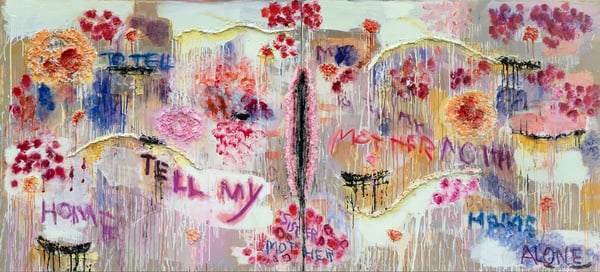
Analyse experte de Tell my sister de Joan Snyder
Style : Abstract Expressionism, Feminist Art · Genre : abstract
Analysis of Joan Snyder’s “Tell my sister”
Joan Snyder’s “Tell my sister” stands as a pivotal work at the intersection of Abstract Expressionism and Feminist Art, two movements rarely reconciled in the mid-20th century. While Abstract Expressionism was historically dominated by male artists championing heroic, purely gestural abstraction, Snyder boldly infused the genre with narrative, bodily experience, and political urgency—a hallmark of her feminist intervention.
Significance within Style and Period
-
Subverting the “Gesture”
Snyder’s signature “stroke” paintings—layered, visceral marks that resemble both paint and text—transform Abstract Expressionism’s spontaneity into a language of female experience. In “Tell my sister”, the aggressive, calligraphic sweeps are not just emotional outpourings but intentional, communicative acts. The title itself implies a message, a whispered or shouted command to a female kin, turning the canvas into a site of solidarity rather than solitary male angst. -
Feminist Content through Abstraction
Unlike the overtly figurative feminist art of her peers (e.g., Judy Chicago), Snyder keeps the content encoded in abstraction. The painting’s “sister” likely refers to shared womanhood, sisterhood, or the artist’s own history. By embedding such personal-political reference within Abstract Expressionist technique, Snyder challenges the movement’s alleged universality, insisting that abstract form can carry gendered, communal meaning. -
Material and Process as Metaphor
The painting’s dense, scraped, and reworked surfaces evoke struggle, layering of memory, and the palimpsest of women’s lives. Snyder often incorporated organic materials (straw, soil, cloth) into her canvases, rooting abstraction in the domestic and the earthy. Even without specific description of the physical work, the title “Tell my sister” suggests a transmission of knowledge or warning, aligning the act of painting with oral history and feminist consciousness-raising. -
Historical Context
Created during the 1970s–80s feminist art movement, this work directly counters the masculinist rhetoric of Abstract Expressionism. Snyder refused to compartmentalize her identity: she was both a “woman artist” and a “painter.” By merging the two, she expanded Abstract Expressionism’s possibilities, proving that abstraction could be a vehicle for political and relational expression without losing its visceral power.
Conclusion
“Tell my sister” is significant not merely as an Abstract Expressionist painting, but as a feminist reclamation of the genre. It demonstrates that the gestural, non-representational canvas can speak to and for a collective, blurring the boundaries between private emotion and public declaration. Snyder’s work reminds us that abstraction is never neutral—it can whisper a name, command an ally, or call out to a sister across time and space.
Visuellement similaire
20 œuvres à la composition et à la palette proches
Spring Eternal
Joan Snyder
Still
Joan Snyder
Song Cycle 4
Joan Snyder
Lepanto, Part VIII
Cy Twombly
Song Cycle 2 (for AW)
Joan Snyder
Auflösung V
Daniel Sambo-Richter
Lepanto, Part IV
Cy Twombly
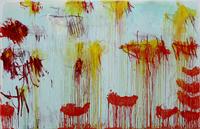
Lepanto, Part XI
Cy Twombly
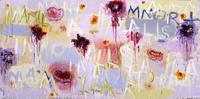
Mamilla Immortalis
Joan Snyder

Untitled, (Blooming, A Scattering of Blossoms & Other Things)
Cy Twombly
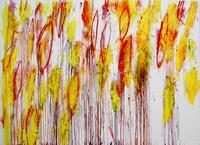
Lepanto, Part I
Cy Twombly
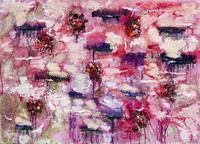
Purple Passion
Joan Snyder
Quattro stagioni I. Primavera
Cy Twombly
Ihtys
Vjeran Čengić
Lepanto, Part XII
Cy Twombly

The Rose (IV)
Cy Twombly
The Last Wizard
Jack Armstrong
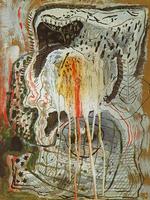
Nude Woman in an Armchair
Salvador Dali
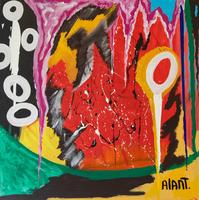
Snow
Alan Tellez
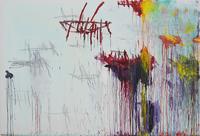
Lepanto, Part VI
Cy Twombly