
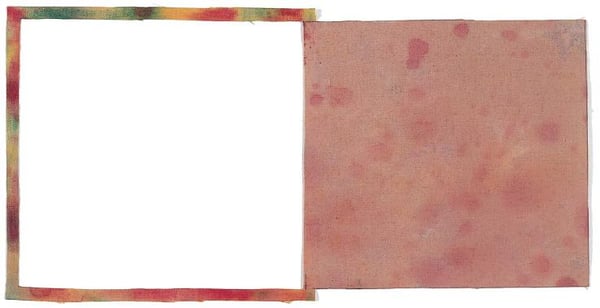
Louis Cane sanatçısının Toile découpée eseri hakkında uzman analizi
Tarz: Color Field Painting · Tür: abstract
Expert Analysis: "Toile découpée" by Louis Cane
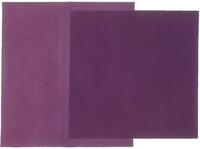
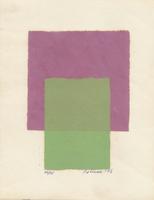
Louis Cane’s “Toile découpée” (French for “cut canvas”) stands as a pivotal work within the Color Field Painting movement, yet it pushes the genre’s boundaries by interrogating the very materiality of painting. Created during Cane’s association with the Supports/Surfaces group, this abstract piece exemplifies how Color Field’s emphasis on flat, unmodulated color and large-scale composition could be extended into a deconstructive, almost sculptural territory.
Significance within Color Field Painting:
While traditional Color Field painters like Helen Frankenthaler or Morris Louis stained or poured pigment onto raw canvas to create luminous fields of color, Cane’s “Toile découpée” literalizes the canvas as a physical object. The work is not merely a surface for color but a cut, folded, or layered structure that makes the support itself the subject. This challenges the viewer to see the canvas not as a passive backdrop but as an active, three-dimensional element—a radical move that aligns with Color Field’s desire to eliminate illusionistic depth, yet adds a new tactile dimension.
Key Analytical Points:
- Deconstruction of the picture plane: By cutting and rearranging the canvas, Cane disrupts the traditional rectangular frame, forcing the color fields to interact in space rather than solely on a flat surface. The cuts create negative spaces and shadows, making the artwork oscillate between painting and relief.
- Color as structure: Despite the physical manipulation, the color remains the primary driver. Broad, saturated swaths (often in primary or secondary hues) maintain the emotional immediacy typical of Color Field, but now the colors are anchored by the canvas’s own edges and folds, not just by brushwork.
- Material self-awareness: Cane’s approach foregrounds the “toile” (canvas) as a found object of sorts, celebrating its raw, unstretched condition. This reflects a broader 1960s–70s impulse to question the medium’s conventions, making “Toile découpée” a bridge between painterly abstraction and conceptual or process art.
Why It Matters:
In “Toile découpée,” Louis Cane expands Color Field’s legacy by proving that the movement’s core principles—color autonomy, scale, and flatness—could survive even when the canvas is literally cut open. The work is significant for its radical simplicity: it retains abstract painting’s sensuous color and scale while introducing a new, fragile physicality. It reminds us that Color Field was never merely about optical effect; it also contained the seeds of its own physical dematerialization.
Görsel olarak benzer
İlişkili kompozisyon ve renk paletine sahip 20 eser
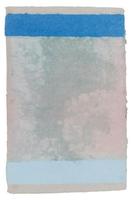
Horizontal Stripes I-1
Kenneth Noland
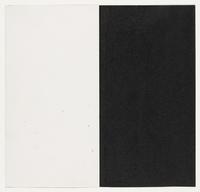
White and Black
Ellsworth Kelly
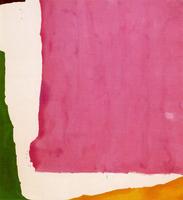
Mauve District
Helen Frankenthaler
Untitled
Brice Marden
Untitled (La Gomera)
Joachim Bandau
Toward a Red
Sam Gilliam
Color sample for painting (#02'27)
Rudolf de Crignis
965
Funasaka Yoshisuke
Untitled Pink Monochrome
Yves Klein
Untitled
Jules Olitski
Bris-signe
Jean Degottex
Untitled
Gego
Toile découpée
Louis Cane
Untitled
Tiberiy Szilvashi
Summer 88, No. 6
Anne Truitt
Hydra
Brice Marden
Lines
Raoul De Keyser
Untitled
Werner Haypeter
Appleby
Anne Appleby
Dialogue 10
Vasile Dobrian