Expert analysis of William James Glackens’s Far from the Fresh Farm Air
Style: New Realism · Genre: genre painting
Expert Analysis: "Far from the Fresh Farm Air" by William James Glackens
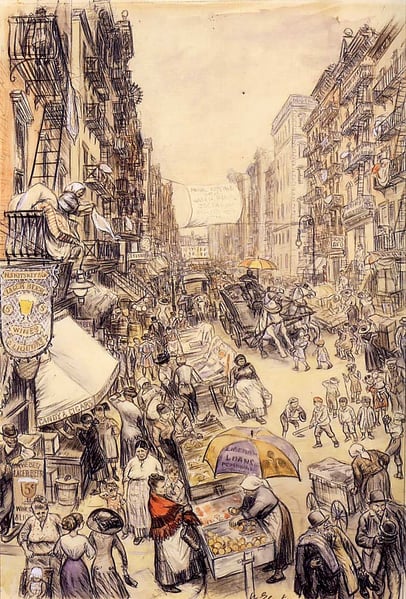
William James Glackens’ Far from the Fresh Farm Air stands as a quintessential example of the New Realist movement—often associated with the Ashcan School—and its commitment to portraying the gritty, unvarnished realities of early 20th-century urban life. As a genre painting, the work captures a slice of everyday existence, but its significance lies in how it uses that ordinary moment to comment on the social and environmental disparities between rural idealism and urban industrialization.
The title itself is a pointed irony: the "fresh farm air" is conspicuously absent. Instead, Glackens depicts a densely packed cityscape, likely a tenement neighborhood or a market scene, where the atmosphere is thick with coal smoke, dust, and the clamor of commerce. His brushwork—loose, energetic, and almost impressionistic—conveys the hurried, dynamic life of the city, while his palette leans toward muted earth tones punctuated by flashes of bright color (perhaps a vendor’s cart or a child’s clothing) that highlight the resilience of human activity amid squalor.
What makes this artwork significant within the New Realist style is its refusal to romanticize or moralize. Unlike earlier genre painters who might have sought picturesque poverty or sentimental narratives, Glackens presents the scene with a documentary-like detachment. The figures are not posed; they are caught in mid-action—a woman haggling, a child playing in the gutter, a laborer hauling crates. This approach aligns Glackens with the Ashcan School’s philosophy of "art for life’s sake," rejecting academic idealization in favor of raw, honest observation.
Furthermore, the work embodies a critical tension central to New Realism: it acknowledges the degradation of the modern city while simultaneously celebrating its vitality. The "fresh farm air" is lost, but the painting suggests a new kind of energy—one born of struggle, community, and survival. In this way, Far from the Fresh Farm Air is both a document of its time and a subtle protest against the myth of pastoral innocence, marking a pivotal moment when American art turned its gaze unflinchingly toward the urban experience.
Visually similar
20 works with related composition and palette
Cross Streets of New York
Everett Shinn
Houston Street
George Luks
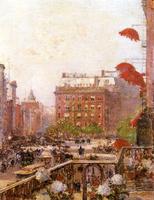
View of Broadway and Fifth Avenue
Childe Hassam
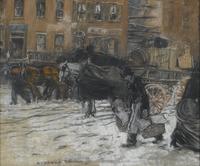
Winter on 21st Street, New York
Everett Shinn
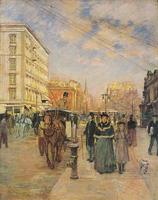
Fifth Avenue at Madison Square
Theodore Robinson
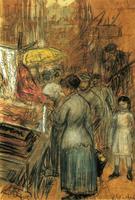
Scene on the Lower East Side
William James Glackens
Conseil Aux Trottins
Theophile Steinlen
Christmas Shoppers
William James Glackens
L'Electeur
Theophile Steinlen
Hester Street
George Luks
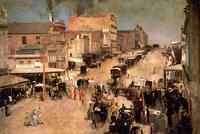
Allegro con brio, Bourke St. West
Tom Roberts
L'Art de Suivre
Theophile Steinlen
The Kalverstraat, Celebrating the Birth of Princess Juliana of the Netherlands, 1 May 1909
Isaac Israels
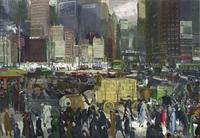
New York
George Bellows
Lower East Side
Robert Spencer
Bleeker and Carmine Streets
George Luks
Merchants Hotel, North 4th Street in Philadelphia
John Rubens Smith
A Spring Morning
Childe Hassam
Presentation of Colors
Edward Lamson Henry
Small Utah Statehood
Robert Theodore Barrett