
Expert analysis of Jean Metzinger’s Paysage aux deux Cyprés
Style: Pointillism, Neo-Impressionism · Genre: landscape
Expert Analysis: "Paysage aux deux Cyprés" by Jean Metzinger
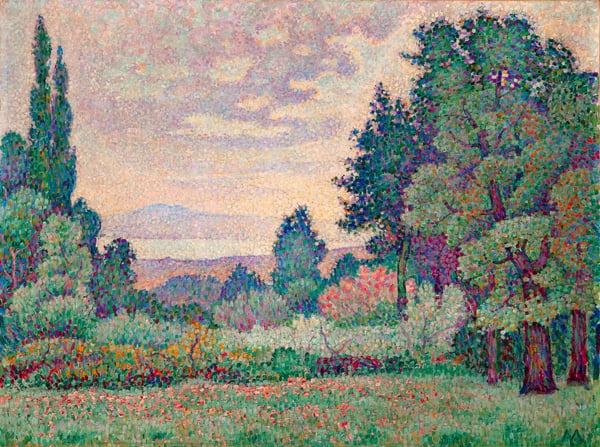
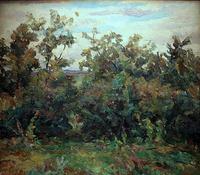
Jean Metzinger’s Paysage aux deux Cyprés (Landscape with Two Cypresses) represents a pivotal moment in the artist’s early development, executed during his brief but intense engagement with Pointillism and Neo-Impressionism. While Metzinger would later become a founding figure of Cubism alongside Georges Braque and Pablo Picasso, this landscape reveals his formative mastery of color theory and the divisionist technique derived from Georges Seurat and Paul Signac.
Significance in Style and Period
The work is a quintessential example of Neo-Impressionist landscape painting, distinguished by its rigorous application of small, distinct dots of pure color. Metzinger’s brushwork here is not merely decorative but follows the scientific color principles of Michel Eugène Chevreul and Ogden Rood: complementary colors (e.g., blue-violet shadows against yellow-green sunlight) are juxtaposed to achieve optical mixing when viewed from a distance. This method imbues the scene with a luminous, vibrating atmosphere, particularly in the sky and foliage.
The composition centers on two slender cypress trees, their vertical forms anchoring the viewer’s gaze while echoing the horizon line. Unlike Seurat’s more static, monumental landscapes, Metzinger introduces a subtle diagonal sweep in the terrain and a rhythmic scattering of brushstrokes that anticipate the dynamic fragmentation of his Cubist phase. The cypresses—a motif later associated with van Gogh—here function as structural pillars, resisting the decorative dispersal of the pointillist dots.
Historical Importance
Painted around 1905–1906, Paysage aux deux Cyprés belongs to Metzinger’s pre-Cubist period, when he was synthesizing Neo-Impressionist color theory with a growing interest in simplified, geometric forms. This work directly precedes his 1908–1909 shift toward analytical Cubism; the cypresses themselves can be read as proto-Cubist “facets” of space, flattened into near-silhouette. The painting thus bridges two revolutionary movements: the optical science of Neo-Impressionism and the conceptual geometry of early Cubism.
In summary, Paysage aux deux Cyprés is significant not only as a pure, vibrant example of Pointillist landscape but as a crucial document of Metzinger’s evolution—a serene landscape that quietly announces the rupture to come.
Visually similar
20 works with related composition and palette
Landscape in Mâcon
Hippolyte Petitjean
Juan-les-Pins Landscape
Theodor Pallady
Далекі гори
Trush Ivan Ivanovych
Landscape near the sea
Giovanni (Nino) Costa
In the Campagna
Giovanni (Nino) Costa
Outskirts of Lausanne
Felix Vallotton
Landscape
Edward Mitchell Bannister
On the outskirts of Mikhailovske village
Hryhorii Havrylenko
Landscape, Sunset
Frederick George Cotman
Sunset landscape
Maximilien Luce
A part of Groettes, Pontoise, Gray Weather
Camille Pissarro
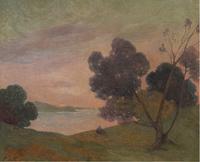
Coucher De Soleil
Ferdinand du Puigaudeau
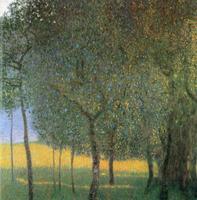
Fruit Trees
Gustav Klimt
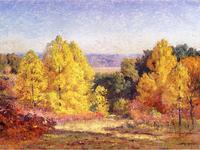
The Poplars
T. C. Steele
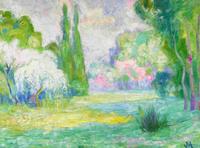
Clairiere
Jean Metzinger
Connecticut Hillside
Emil Carlsen
The Countryside in the Vicinity of Conflans Saint Honorine
Camille Pissarro
The Farmer's Lawn
Julian Alden Weir
Tulip Tree, Greenwich
John Henry Twachtman
Bushes
Pyotr Konchalovsky