
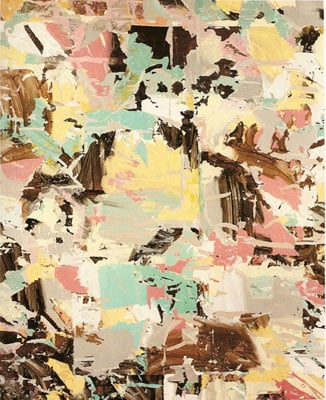
Arrachement
Expert analysis of Andre-Pierre Arnal’s Arrachement
Style: Art Informel · Genre: abstract
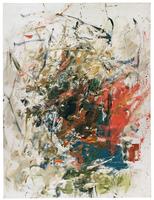
André-Pierre Arnal’s Arrachement (French for “tearing” or “uprooting”) stands as a powerful exemplar of Art Informel, an abstract movement that flourished in post-war France as a radical departure from geometric abstraction and figurative narrative. Within this context, Arnal’s work is significant for its emphatic materiality and performative gesture—two hallmarks of Informel that privilege the physical act of creation over premeditated composition.
Although specific visual details of Arrachement are not supplied, the title itself is the key to its meaning. “Arrachement” implies a violent, deliberate act of separation or removal. In Art Informel, such an act is not merely destructive but generative: the artwork often emerges from tearing, scratching, or otherwise destabilizing the canvas or paint surface. Arnal likely exploits this by using torn canvas, layered laceration, or thick impasto that seems to be “wrenched” from the support, creating a raw, organic topography. This aligns with Informel’s rejection of traditional pictorial space in favor of a “painting-as-event”—where the viewer confronts the artist’s physical energy and the material’s own resistance.
Significantly, Arrachement reflects the existentialist undercurrent of the movement. In the aftermath of World War II, many European artists turned to spontaneous, anti-formal practices to express a fractured sense of being. By making tearing the core metaphor, Arnal embodies this anxiety: the artwork becomes a scar, a rupture in the surface that mirrors a deeper psychological or historical uprooting. Yet it is also an act of liberation from convention—the torn edge defies the canvas’s traditional rectangular boundary, bleeding into real space.
Arnal’s place within Art Informel is distinct because he later became associated with the Supports/Surfaces group (emerging in the late 1960s), which pushed material deconstruction even further. Arrachement can thus be seen as an early, visceral precursor to that movement—an investigation of the canvas as object rather than window. Here, Arnal strips painting to its essentials: substrate, pigment, gesture. The “tearing” is not a flaw but the very subject of the work.
In summary, Arrachement is significant for its direct, almost violent materiality; its existential resonance; and its role in bridging the spontaneous energy of Art Informel with the later, more conceptual deconstruction of the painting support. It challenges the viewer to see abstraction not as a formal exercise but as a physical record of an act—an uprooting that remains both violent and poetic.
Visually similar
20 works with related composition and palette
Untitled (Composition)
Robert Goodnough
Une longue promenade
Aurel Cojan
Untitled
Olga Albizu
Untitled Landscape, Bellport (No.256)
Arthur Pinajian
Untitled
Vilen Barsky
Untitled
Vilen Barsky
Composition with Black
Alexander Bogen
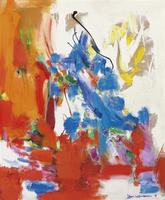
Wild Vine
Hans Hofmann
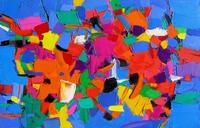
Equilibrium
Olga Albizu
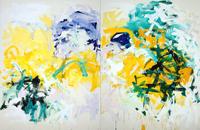
Untitled
Joan Mitchell
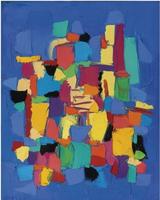
Untitled
Olga Albizu
Two Figures
Willem de Kooning
Art Like Love Is Dedication
Hans Hofmann
Paul Emile Borduas Sans Titre
Paul-Émile Borduas
Untitled
Joan Mitchell
The Conjurer
Hans Hofmann
Untitled
Joan Mitchell
Untitled
Joan Mitchell
Clock
Philip Guston
La Chatiere
Joan Mitchell